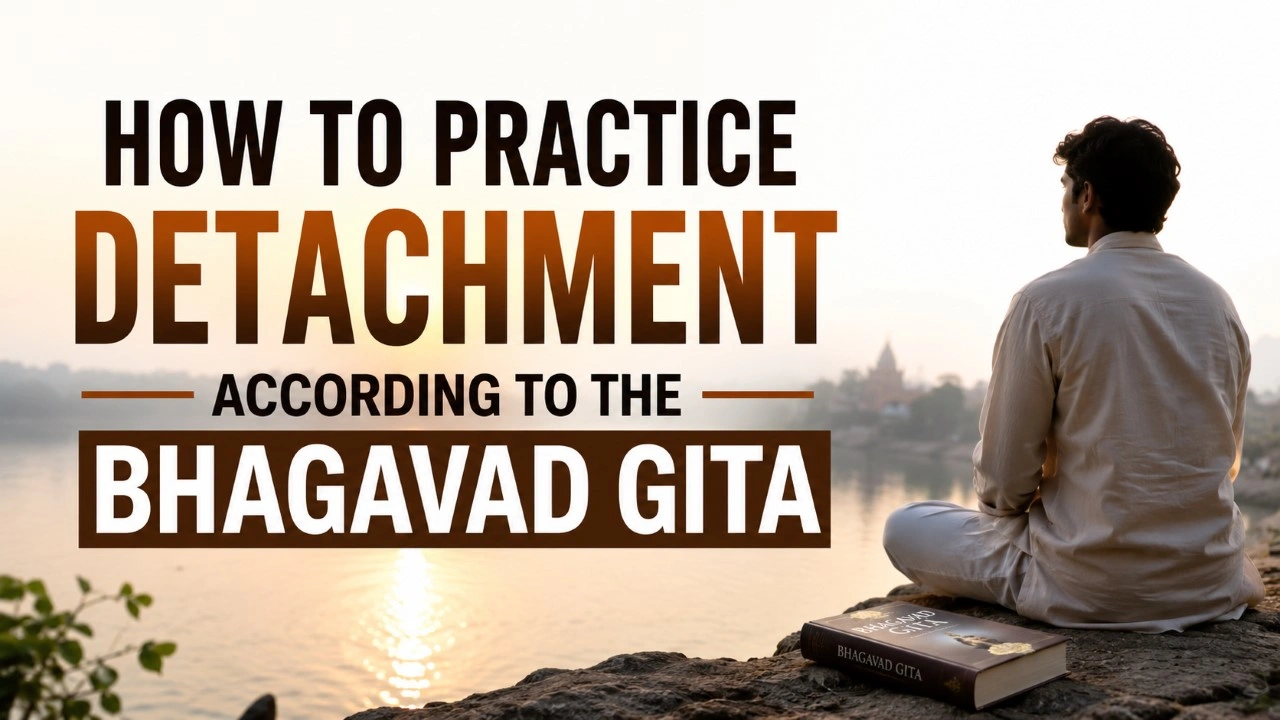

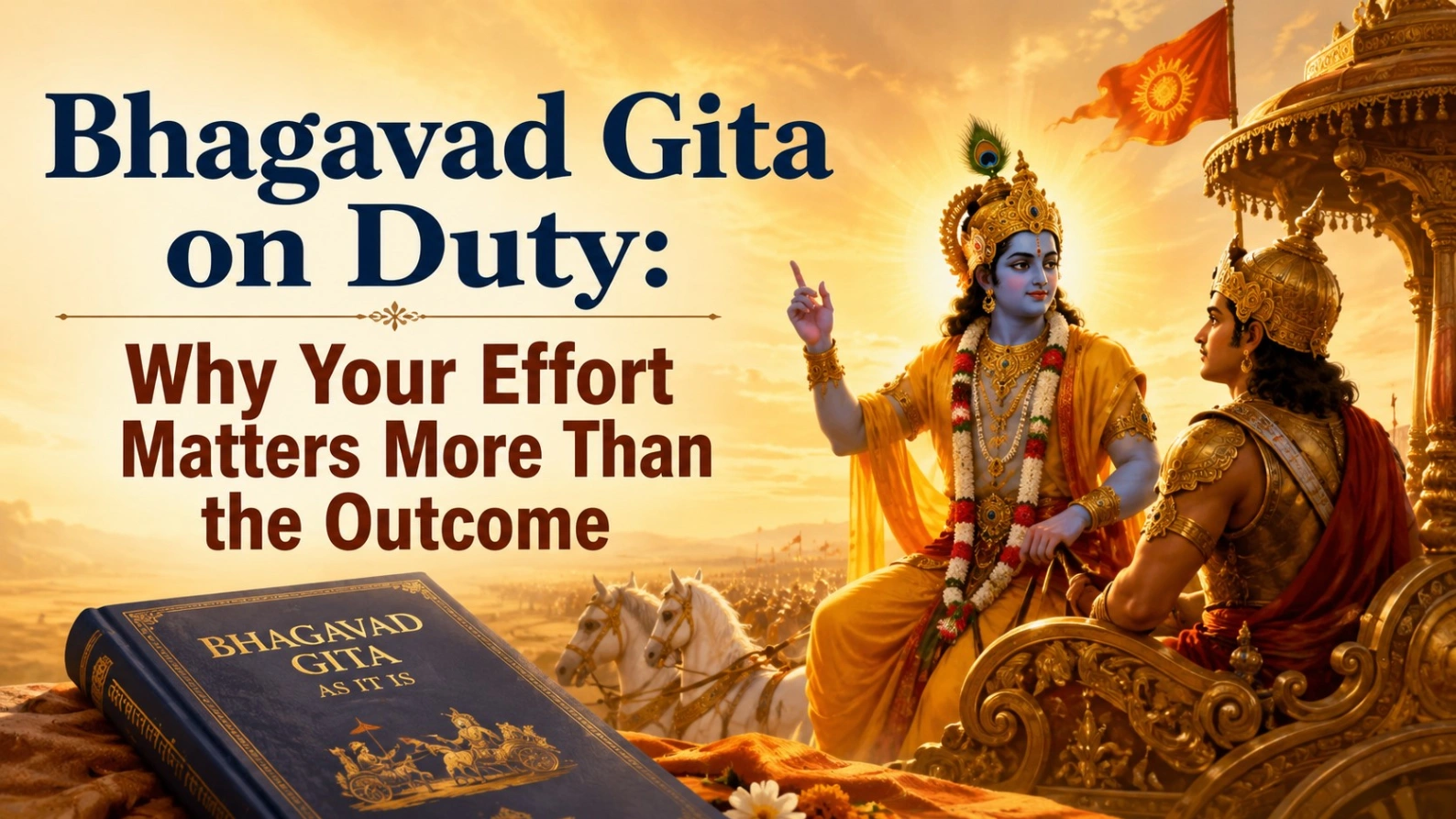
The Bhagavad Gita on duty gives one of the most powerful lessons for modern life: your effort is in your hands, but the outcome is not always under your control. This teaching is deeply connected with karma, responsibility, detachment and inner peace. In a world where people constantly worry about results, success, failure, recognition and comparison, the Bhagavad Gita reminds us to focus on sincere action rather than emotional attachment to the final result.
Many people today feel stressed not because they are not working hard, but because they are mentally trapped in the outcome. A student studies but keeps worrying about marks. A professional works hard but keeps thinking about promotion. A business owner gives their best but remains anxious about profit. A person does good deeds but waits for appreciation. This constant attachment to results creates pressure, fear and restlessness.
The Bhagavad Gita does not say that results are unimportant. It teaches that results should not become the controller of your peace. Your duty is to act with honesty, discipline and awareness. The result will come according to many factors, some visible and some beyond your control. When you understand this deeply, you do not become careless. Instead, you become more focused, more stable and more peaceful.
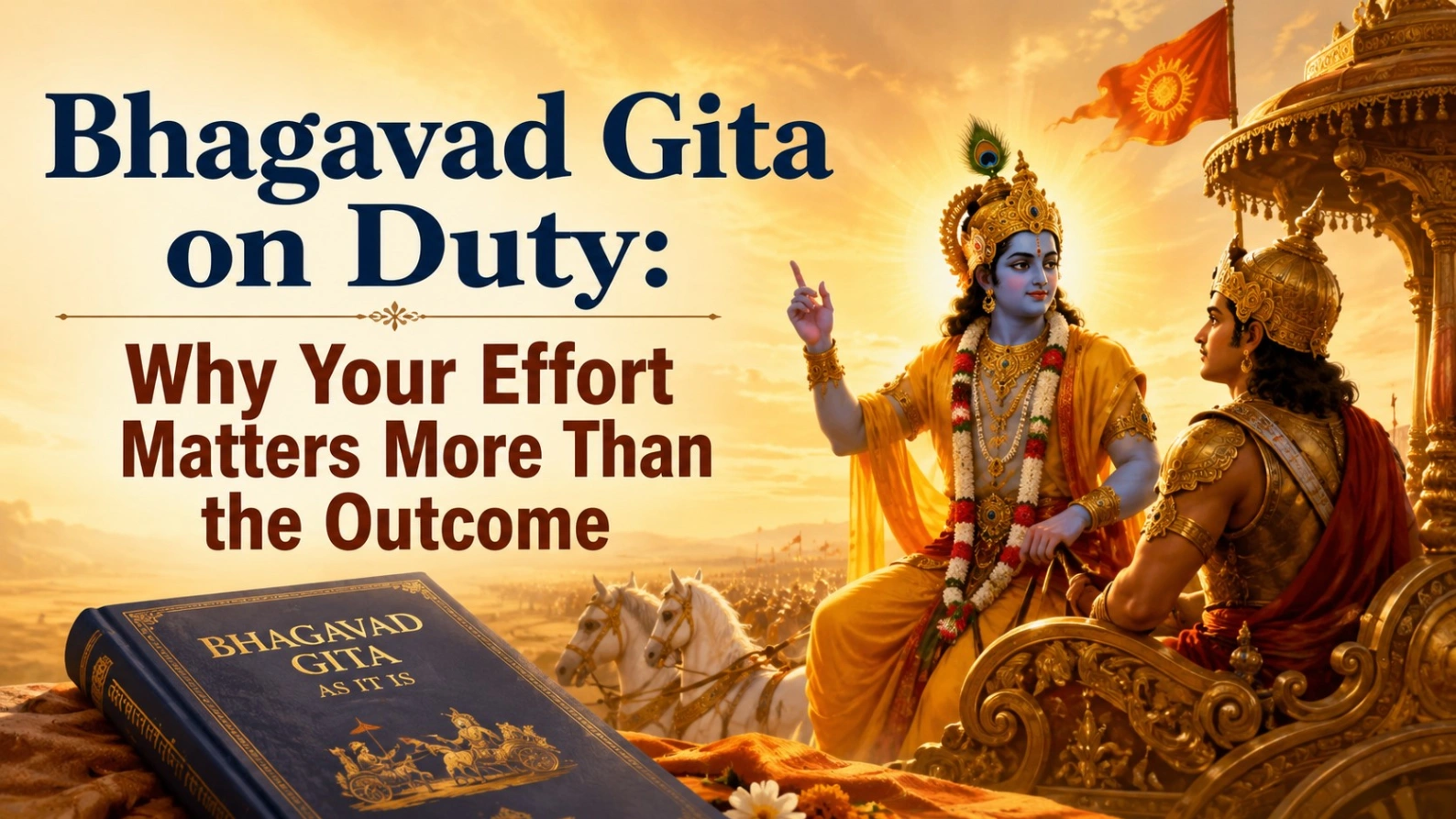
What Does the Bhagavad Gita Say About Duty?
In the Bhagavad Gita, duty means doing what is right according to your role, situation, values and inner wisdom. Duty is not only about work or responsibility. It is also about living with sincerity, courage and awareness. Lord Krishna teaches Arjuna that avoiding one’s duty out of fear, confusion or attachment does not bring peace. True peace comes when one performs the right action with a steady mind.
Arjuna was standing on the battlefield, overwhelmed by emotions. He was confused about what he should do. His mind was filled with fear, grief and attachment. At that moment, Krishna did not simply motivate him to fight. He guided him to understand the deeper meaning of karma, duty and detachment.
This is why the Bhagavad Gita is not only a religious scripture. It is also a practical guide for daily life. Whether you are a student, parent, employee, leader, seeker or entrepreneur, the teaching remains relevant: do your duty with full effort, but do not let the outcome disturb your inner balance.
Design Your Destiny
If you want to understand how to live with clarity, purpose and inner strength, join the Design Your Destiny program. This program helps you apply spiritual wisdom in practical life, overcome confusion and move forward with a peaceful, focused and awakened mind.
Start Your Journey!Why Effort Matters More Than the Outcome
Effort matters more than outcome because effort is your responsibility. Outcome is influenced by many things: timing, circumstances, other people’s decisions, past actions, environment and divine will. You can control your intention, preparation, discipline and action. But you cannot fully control how the world responds.
This does not mean you should ignore goals. Goals give direction. But attachment to goals creates anxiety. The Bhagavad Gita teaches a balanced way: work with dedication, but do not become mentally dependent on the result.
For example, if a student studies sincerely, their duty is fulfilled through effort, discipline and concentration. The marks are important, but they are not the only measure of the student’s worth. Similarly, if a person works honestly in their profession, their duty is to give their best. Promotion, praise or recognition may come, but these should not become the foundation of their peace.
When your happiness depends only on the result, your mind becomes unstable. If the result is good, you become excited. If the result is not as expected, you feel broken. But when your peace is rooted in right effort, you become stronger in both success and failure.
Understanding Karma Yoga in the Bhagavad Gita
Karma Yoga in the Bhagavad Gita is the path of selfless action. It teaches us to perform our duties without selfish attachment to the fruits of action. This is also known as Nishkama Karma, which means action without personal craving for results.
Karma Yoga does not mean working without purpose. It means working without ego, fear and obsession. It means doing your best because it is the right thing to do, not only because you want a particular reward.
This teaching is very important in modern life. Many people work only for external validation. They want likes, praise, money, status or approval. When they do not receive these things, they feel disappointed. Karma Yoga shifts the focus from “What will I get?” to “How sincerely can I perform my duty?”
This change in mindset brings great freedom. You still work hard. You still aim for excellence. But your mind is not constantly disturbed by expectations. You become more peaceful because your identity is no longer dependent on success or failure.
Bhagavad Gita on Results and Detachment
The Bhagavad Gita on results teaches that attachment to the fruit of action creates suffering. Detachment does not mean giving up action. It means giving up mental dependence on the outcome.
There is a big difference between caring about your work and being attached to results. Caring makes you responsible. Attachment makes you anxious. Caring improves your effort. Attachment disturbs your peace.
When you are attached to results, your mind keeps moving into the future. You think, “What if I fail? What if people judge me? What if I don’t get what I want?” This creates stress before the result even comes. But when you practice detachment, your attention returns to the present action.
Detachment helps you work better because your energy is not wasted in fear. You become more focused, more creative and more stable. You stop reacting emotionally to every small delay, mistake or obstacle. This is the real power of Krishna’s teaching on duty and detachment.
How to Focus on Effort, Not Results
Focusing on effort instead of results is a practice. It does not happen in one day. The mind is used to measuring everything through outcomes. But slowly, with awareness, you can train yourself to return to action.
Start by asking yourself, “What is in my control right now?” This question immediately brings clarity. You may not control the final result, but you can control your preparation. You can control your honesty. You can control your discipline. You can control your response.
If you are preparing for an exam, focus on study hours, revision, understanding and calmness. If you are working on a project, focus on quality, consistency and communication. If you are facing a personal challenge, focus on patience, right action and emotional balance.
This simple shift can reduce overthinking. Instead of worrying about everything that may happen, you begin doing what needs to be done. This is how Bhagavad Gita wisdom becomes practical in daily life.

Bhagavad Gita on Success and Failure
The Bhagavad Gita teaches us to remain balanced in success and failure. Success should not inflate the ego, and failure should not destroy self-worth. Both are temporary experiences. What truly matters is whether your action was sincere, conscious and aligned with dharma.
Many people become arrogant when they succeed. They start believing that they alone control everything. On the other hand, when they fail, they feel hopeless and powerless. Both reactions come from attachment.
Krishna’s teaching helps us rise above this emotional swing. If success comes, accept it with gratitude. If failure comes, learn from it with humility. Do not stop doing your duty. Do not lose your inner peace.
Failure is not always a sign that your effort was useless. Sometimes it becomes a teacher. It shows where you need more preparation, patience or maturity. When you are not attached to results, you can learn from failure without being crushed by it.
Bhagavad Gita in Daily Life
The Bhagavad Gita in daily life is not limited to meditation or spiritual study. Its teachings can be applied in every situation. Every day gives us opportunities to practice duty, karma and detachment.
At work, you can practice Karma Yoga by giving your best without constantly seeking praise. In relationships, you can do your duty with love without expecting everyone to behave exactly as you want. In studies, you can focus on learning instead of only marks. In spiritual practice, you can remain consistent without demanding instant experiences.
Even simple daily tasks can become spiritual when done with awareness. Cooking, cleaning, working, serving, studying or speaking can become part of your sadhana when performed with sincerity and without ego.
The real meaning of spiritual life is not escaping from responsibilities. It is performing responsibilities with a higher state of consciousness. This is the beauty of the Bhagavad Gita’s teaching on karma and duty.
Krishna’s Teaching on Duty and Responsibility
Krishna’s teaching on duty and responsibility is deeply practical. He does not ask Arjuna to run away from life. He asks him to awaken his understanding and act from clarity.
Many times, people avoid responsibility because they fear failure. They think, “What if I cannot do it perfectly?” But the Gita teaches that avoiding duty due to fear is not freedom. Real freedom comes when you act with courage and surrender the result.
Responsibility does not mean carrying the whole world on your shoulders. It means doing what is rightfully yours to do. You are responsible for your intention, effort and attitude. You are not responsible for controlling every result.
This understanding brings emotional maturity. You stop blaming yourself for everything. You also stop blaming others for everything. You become centered in action.

How Bhagavad Gita Helps With Stress About Results
Stress about results usually comes from fear of the future. The mind imagines failure, rejection, loss or disappointment. It then starts reacting as if those things have already happened.
The Bhagavad Gita helps by bringing the mind back to the present duty. It reminds you that worry does not improve the result. Right action improves your chances. A calm mind improves your performance. Detachment protects your peace.
When you stop worrying about results, you do not become lazy. In fact, you often become more productive because your mind is clear. You are not wasting energy in fear. You are using energy in action.
This is especially helpful for students, professionals and people going through major life decisions. Whenever the pressure of outcome becomes too heavy, return to this simple teaching: do your karma, give your best and let go of the rest.
The Meaning of Nishkama Karma
Nishkama Karma means performing action without selfish desire for the fruit of action. It is one of the most important ideas in the Bhagavad Gita.
This does not mean you should have no goals or dreams. It means your action should not be polluted by greed, ego or fear. You can work for success, but you should not lose yourself in the craving for success.
Nishkama Karma purifies the mind. It reduces ego because you begin to see yourself as an instrument of a higher purpose. You work sincerely, but you do not claim complete ownership over the result. This brings humility, peace and devotion.
In practical life, Nishkama Karma means doing good because it is good, working honestly because honesty matters, helping others without always expecting return and continuing your duty even when appreciation is delayed.
Why Attachment to Outcome Disturbs Inner Peace
Attachment to outcome disturbs inner peace because it makes the mind dependent on something uncertain. The result may come late. It may come differently than expected. It may not come at all. If your peace depends on such uncertainty, your mind will naturally remain restless.
The Bhagavad Gita on inner peace teaches that peace comes from right understanding. When you understand that your role is effort and not complete control, you become lighter. You stop fighting reality. You stop forcing life to happen exactly according to your plan.
This does not make you weak. It makes you wise. A detached person is not careless. A detached person is deeply committed, but inwardly free.

How to Practice Bhagavad Gita Teachings Every Day
To practice this teaching, begin your day with a clear intention. Ask yourself, “What is my duty today?” Then focus on doing it well. Do not begin the day by worrying about every possible result.
During work, notice when your mind becomes anxious about the outcome. Pause and bring your attention back to the action. Remind yourself, “My duty is sincere effort.”
At the end of the day, review your effort honestly. Did you act with awareness? Did you give your best? Did you avoid your duty because of fear? This kind of reflection helps you grow without guilt.
You can also repeat a simple inner reminder: “I will do my duty with full effort and surrender the result.” Over time, this thought becomes a powerful spiritual practice.
The Bhagavad Gita on duty gives a timeless message: effort is your responsibility, but the outcome is not fully in your hands. When you understand this, life becomes lighter and more meaningful. You stop running after results with fear. You start acting with clarity, courage and peace.
Karma Yoga teaches you to work without attachment. Nishkama Karma teaches you to act without selfish craving. Krishna’s teaching on duty reminds you that avoiding responsibility does not bring peace, but performing your duty with awareness can transform your life.
In modern life, this wisdom is more relevant than ever. Whether you are dealing with work pressure, exam stress, relationship expectations or personal goals, the message remains the same: give your best, stay rooted in dharma and do not let results control your peace.
When your effort becomes sincere and your mind becomes detached, every action becomes a path to inner growth. This is the real beauty of the Bhagavad Gita’s wisdom for daily life.
Personal Session
Feeling stuck, stressed or confused about your life direction? Book a personal session to receive guided support, spiritual clarity and practical steps for your inner growth. A personal session can help you understand your challenges deeply and move ahead with confidence and peace.
Book Now