

Have you ever known exactly what the right thing to do was, yet found yourself unable to act? Perhaps you were afraid of failing, worried about what people would think, or anxious that your efforts might not produce the results you hoped for. These fears are common, and they often prevent us from walking the path that truly belongs to us. Learning how to follow your dharma without fear or attachment is one of the most profound teachings of the Bhagavad Gita, and it continues to guide millions of people who seek clarity, courage, and inner peace in today's fast-moving world.

The Bhagavad Gita teaches that every individual has a unique purpose. This purpose, known as dharma, is not simply a profession or social role but the way we express our highest nature through our thoughts, actions, and choices. When we understand our dharma and perform it without becoming attached to success or failure, we experience freedom from anxiety and discover a deeper sense of fulfillment. This timeless wisdom is beautifully explained in Life Changing MahaMantras: The Art of Living the Gita, which presents these spiritual principles in a practical way for modern readers.
Design Your Destiny
Your life's greatest transformation begins when you understand your true purpose. Join our Design Your Destiny program to discover your dharma, overcome fear, practice Karma Yoga, and apply timeless Bhagavad Gita wisdom in your everyday life. Learn practical spiritual tools that help you make confident decisions, build inner peace, and create a meaningful life filled with clarity and purpose.
Start Your Journey Today!One of the biggest misconceptions about spirituality is that it asks us to withdraw from life. The Bhagavad Gita teaches exactly the opposite. Krishna never asks Arjuna to abandon his responsibilities. Instead, He encourages him to fulfill them with courage, wisdom, and complete dedication. The message is clear: life becomes meaningful not when we escape challenges but when we face them with the right understanding.
At the heart of this teaching are three interconnected principles: dharma, karma, and detachment. Together, they provide a complete framework for living with confidence, purpose, and peace. Understanding these principles can transform the way we make decisions, handle relationships, pursue success, and deal with uncertainty.
Understanding the True Meaning of Dharma
Many people translate dharma simply as religion, but the Bhagavad Gita gives it a much broader and deeper meaning. Dharma is your natural duty, your inner calling, and the way of living that is aligned with truth. It is the responsibility that arises from your character, abilities, and circumstances. Rather than asking what you want from life, dharma asks what life is asking of you.
Every individual has a different dharma. A teacher serves through education, a doctor through healing, a parent through nurturing, and a leader through responsible decision-making. The outer roles may differ, but the inner principle remains the same. Dharma is fulfilled when our actions are guided by integrity instead of selfish desire.
Understanding the dharma meaning also requires us to look beyond temporary emotions. We often confuse comfort with purpose. We choose what feels easy rather than what is right. Yet growth rarely happens within the boundaries of comfort. Dharma often calls us toward courage, discipline, and service, even when the path appears uncertain.
When we begin to live according to our dharma, life gains direction. Decisions become clearer because they are no longer based on fear or social approval but on a deeper understanding of who we are and what we are meant to contribute.
Why Fear Pulls Us Away from Our Purpose
Fear is one of the greatest obstacles to fulfilling our dharma. It appears in many forms. Sometimes it is the fear of failure. At other times it is the fear of rejection, criticism, uncertainty, or loss. While these fears seem different on the surface, they often arise from the same source: attachment to outcomes.
Imagine someone who dreams of starting a meaningful project but never begins because they fear it may not succeed. Another person remains in an unfulfilling career because they fear financial uncertainty. Someone else avoids speaking the truth because they fear disappointing others. In each case, fear prevents action, and life gradually moves further away from its authentic purpose.
The Bhagavad Gita reminds us that fear grows stronger whenever we identify ourselves solely with external achievements. If our happiness depends entirely on praise, wealth, status, or recognition, every decision becomes stressful because we constantly worry about losing what we have or failing to gain what we want.
This is why Krishna teaches Arjuna to shift his attention from results to responsibility. When we focus on doing what is right instead of worrying about what will happen afterward, fear naturally begins to lose its hold over the mind.

Karma and Dharma: Understanding Their Relationship
The words karma and dharma are often used together, yet they refer to different aspects of life. Karma means action. Every thought, every word, and every decision creates karma. Dharma, on the other hand, determines which actions are in harmony with truth and wisdom.
You cannot avoid karma because every moment of life involves action. Even choosing not to act is a form of action. The real question is whether your actions arise from awareness or from fear. This is where dharma becomes essential. It acts as an inner compass, helping us choose actions that contribute to personal growth and collective well-being.
The Bhagavad Gita introduces the concept of Karma Yoga, which is the practice of performing one's duties selflessly and wholeheartedly. Karma Yoga does not ask us to suppress ambition or avoid success. Instead, it teaches us to work with complete dedication while remaining free from anxiety about the outcome. This approach not only improves the quality of our work but also brings remarkable mental peace.
When our actions are aligned with our dharma, life feels meaningful regardless of external results. We begin to experience satisfaction in the process itself rather than depending entirely on future rewards.
The Wisdom of Detachment
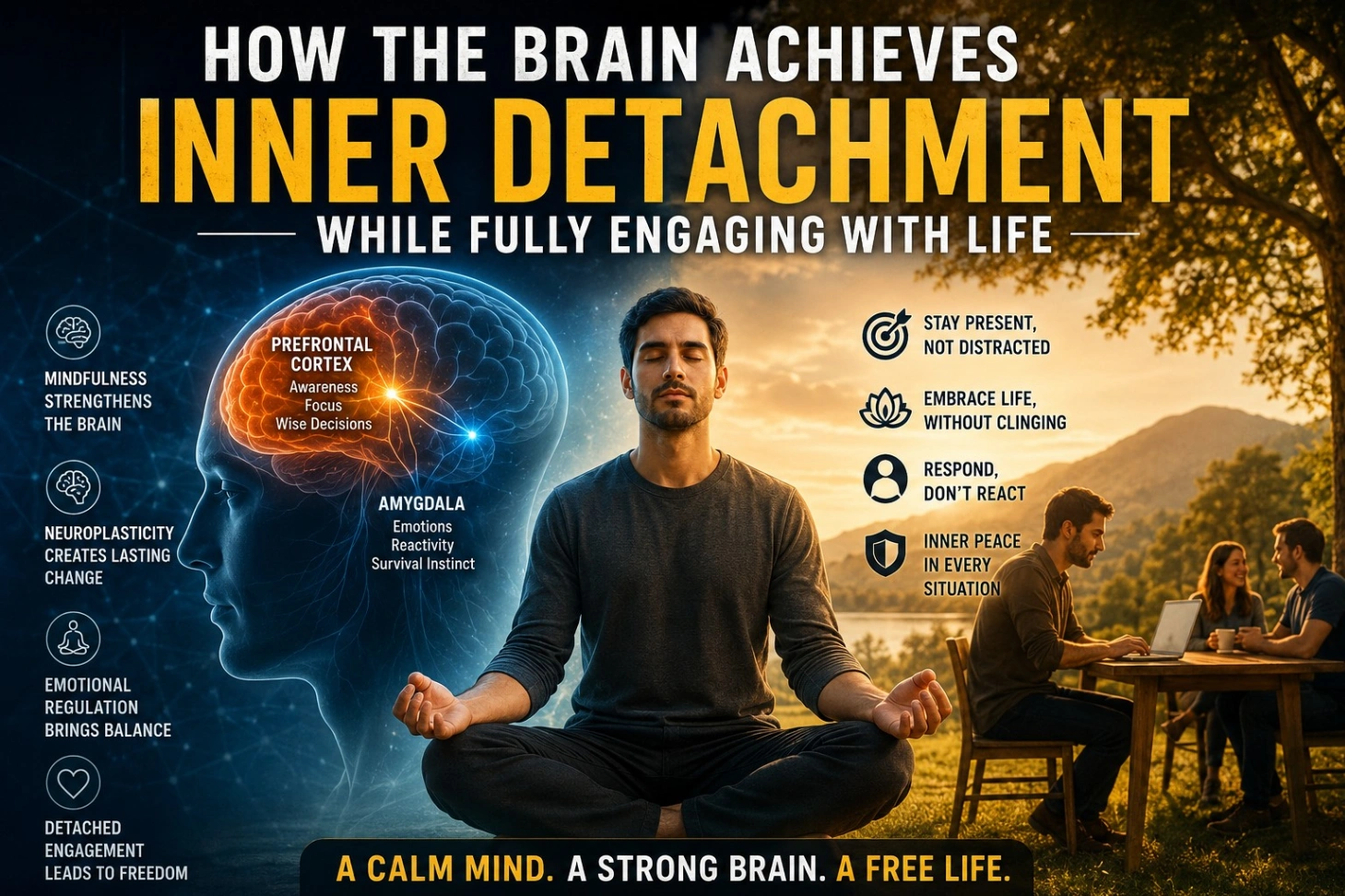
The word detachment is often misunderstood. Many people imagine that becoming detached means giving up relationships, emotions, or responsibilities. The Bhagavad Gita presents a much more balanced understanding.
Detachment does not mean caring less. It means clinging less.
A detached person continues to love deeply, work sincerely, and contribute wholeheartedly, but their inner peace is no longer controlled by success or failure. They understand that while effort belongs to them, results unfold according to many factors beyond their control.
This is one of the most liberating teachings in the Bhagavad Gita. When we stop measuring our worth by outcomes, we become free to give our best without fear. We learn to act with excellence because excellence itself becomes the reward.

Rather than making us passive, detachment makes us more effective. A calm mind makes wiser decisions than an anxious one. Someone who is not overwhelmed by fear or attachment can respond thoughtfully even during difficult situations.
In this way, detachment in the Bhagavad Gita is not about escaping life. It is about participating fully in life while remaining inwardly free.
Personal Session
If you're feeling confused about your purpose, struggling with fear, or finding it difficult to let go of attachment, a personalized spiritual guidance session can help. Book a Personal Session to receive practical insights based on timeless Gita wisdom, gain clarity about your life's direction, and learn simple techniques to cultivate courage, inner peace, and lasting transformation.
Book Now