
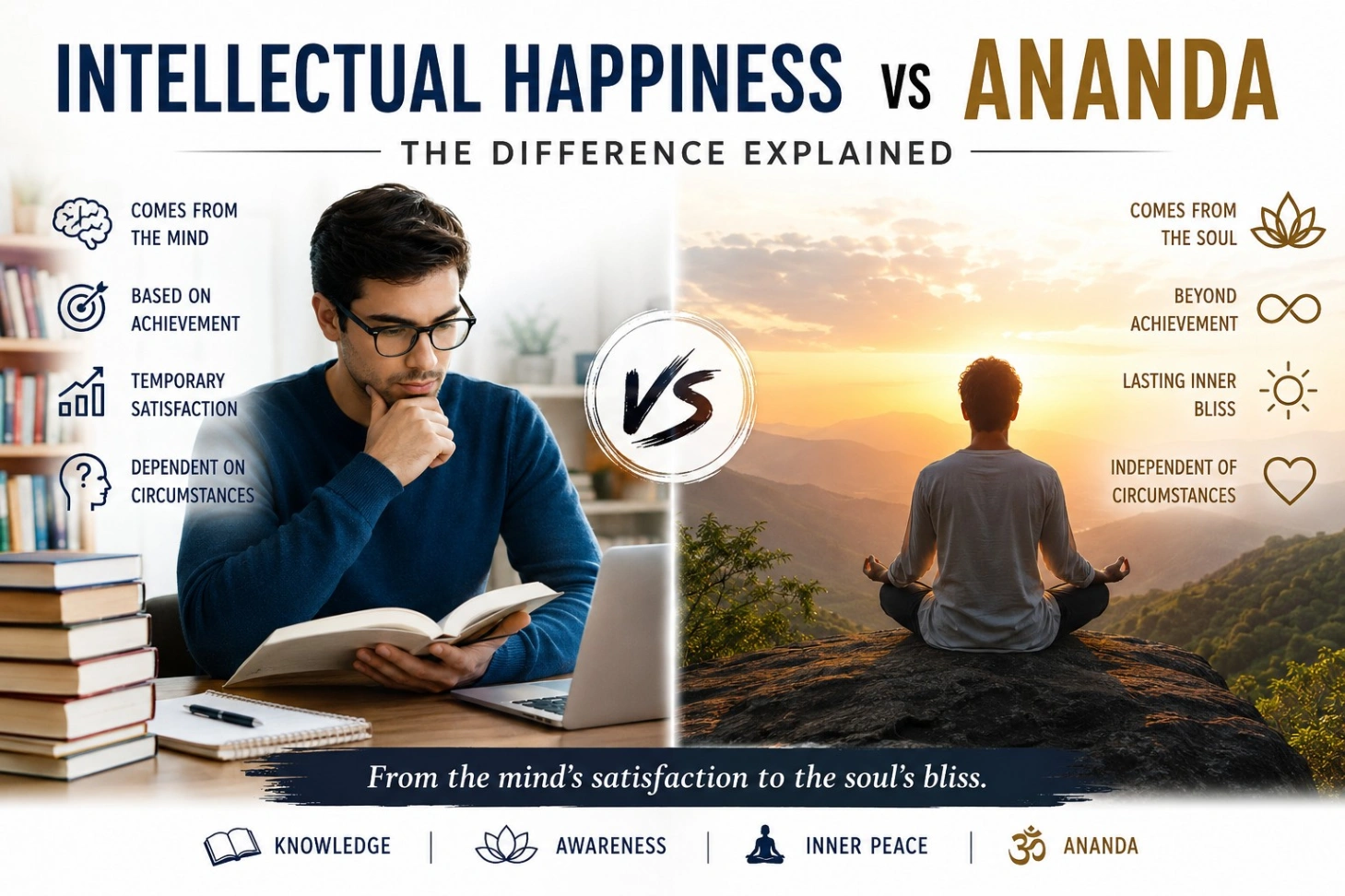
We often seek happiness through understanding. We read, reflect, solve problems, achieve goals, and feel uplifted when life begins to make sense. Yet the difference between happiness and bliss becomes clear when we notice that even meaningful intellectual happiness changes with circumstances. A new insight, a compliment, a completed task, or an achievement may lift the mind, but the feeling can rise and fall. Ananda points to something quieter: a spiritual happiness that is not dependent on getting, proving, or becoming anything.
There is nothing wrong with enjoying learning, recognition, or clarity. The question is whether the mind alone can provide lasting happiness. When we depend only on thought, achievement, and external validation for joy, happiness remains conditional. Ananda, by contrast, is described as an inner fullness discovered when the restless search of the mind begins to settle.
What Is Intellectual Happiness?
Intellectual happiness is the satisfaction that comes from the mind. It may arise when you understand a difficult idea, make a wise decision, complete an important project, win an argument, or receive appreciation for your intelligence. It can come from reading, studying, creating, building a career, or finding answers to questions that once confused you.
This happiness matters because the intellect helps us navigate life. It helps us make choices, communicate clearly, and grow through experience. Learning can feel deeply fulfilling because it creates a sense of purpose and progress.
However, intellectual happiness usually has a condition attached to it. It depends on an outcome, a conclusion, an achievement, or a favourable image of ourselves. When that condition changes, the happiness can change too. The same mind that feels proud after finding an answer may become restless when it faces a new uncertainty. This is why a person can be highly educated, successful, and intellectually stimulated, yet still experience an inner emptiness.
Design Your Destiny
Ready to move beyond temporary happiness and discover a deeper connection with yourself? Join Design Your Destiny to explore self-awareness, inner transformation, meditation, and conscious living in a practical and meaningful way.
Start Your JourneyWhy Happiness of the Mind Does Not Always Last
The mind naturally moves from one object to another. Once it receives what it wanted, it begins looking for a new challenge, answer, or achievement. This is not a flaw. It is simply how the mind works. But it explains why temporary happiness rarely becomes lasting happiness.
A promotion may bring joy and relief. Soon, it becomes normal, and new targets or fears take its place. The mind keeps evaluating and comparing. When we expect a changing experience to become our permanent source of peace, disappointment follows.
This is why happiness vs pleasure is an important distinction. Pleasure may come from comfort, praise, food, entertainment, or sensory enjoyment. Intellectual happiness may come from insight and accomplishment. Both can enrich life, but neither has to be permanent.
The search for true happiness begins when we understand this without becoming negative about life. We do not have to give up ambition, learning, relationships, or enjoyment. We only need to stop asking them to provide a security they were never meant to provide.
What Is Ananda?
Ananda is a Sanskrit word commonly translated as bliss, joy, or deep inner fullness. In spiritual discussions, Ananda meaning goes beyond excitement or emotional pleasure. It refers to a state that is not dependent on a particular achievement, possession, or situation. It is often called divine bliss because it is connected with recognising one’s deeper nature rather than the changing movements of the mind.
Ananda in Hinduism is often discussed in relation to the Self, consciousness, and Vedanta. It does not mean a permanent smile or a life without difficulty. A person may still meet grief, responsibility, loss, or uncertainty. The difference is that inner peace is no longer completely controlled by these experiences. Beneath the changing surface of life, there can be a steadier awareness.
This is why Ananda spiritual meaning is not “feeling happy all the time.” It is freedom from constantly needing life to look a certain way before we can feel whole. It is an inner state in which joy does not have to be earned from the outside.
Sat Chit Ananda: Meaning and Spiritual Context
The phrase Sat Chit Ananda is central to many Vedantic explanations of the Self and ultimate reality. Sat is often understood as being or truth, Chit as consciousness, and Ananda as bliss. Together, Sat Chit Ananda meaning points toward the idea that our deepest nature is not limited to changing thoughts, moods, roles, or circumstances.
Sat Chit Ananda in Hinduism is not only a phrase to memorise. It invites an inward question: Who am I when the mind is quiet? What remains when I am not trying to prove myself, fix myself, or become someone else? In this language, Brahman and Ananda are connected because ultimate reality is described as fullness, awareness, and existence.
This may sound abstract, yet most people have known brief natural stillness: watching the sky, being present with someone they love, or resting after meditation. These moments may not be Ananda in its fullest sense, but they show that peace is possible when constant mental commentary softens.
Happiness, Pleasure, Contentment, and Bliss
It helps to understand happiness vs contentment as well as happiness vs pleasure. Pleasure is usually linked with an enjoyable experience. It is immediate and often sensory. Happiness is broader: it may come from relationships, health, achievement, or meaningful work. Contentment is a quiet appreciation of what is already present. It does not demand constant excitement.
Bliss, or Ananda, is deeper in spiritual language. It is not based on whether the day is exciting, whether others approve of us, or whether every desire has been fulfilled. The difference between happiness and bliss is therefore not that happiness is bad and bliss is good. Happiness is usually an experience that comes and goes, while bliss points to an inner ground of being that is less dependent on change.
True happiness vs pleasure becomes clearer when we stop chasing a peak feeling. True happiness includes stability, gratitude, clarity, and the ability to remain connected with ourselves even when life is imperfect. It can coexist with action, ambition, and love.

Intellectual Happiness vs Ananda: The Core Difference
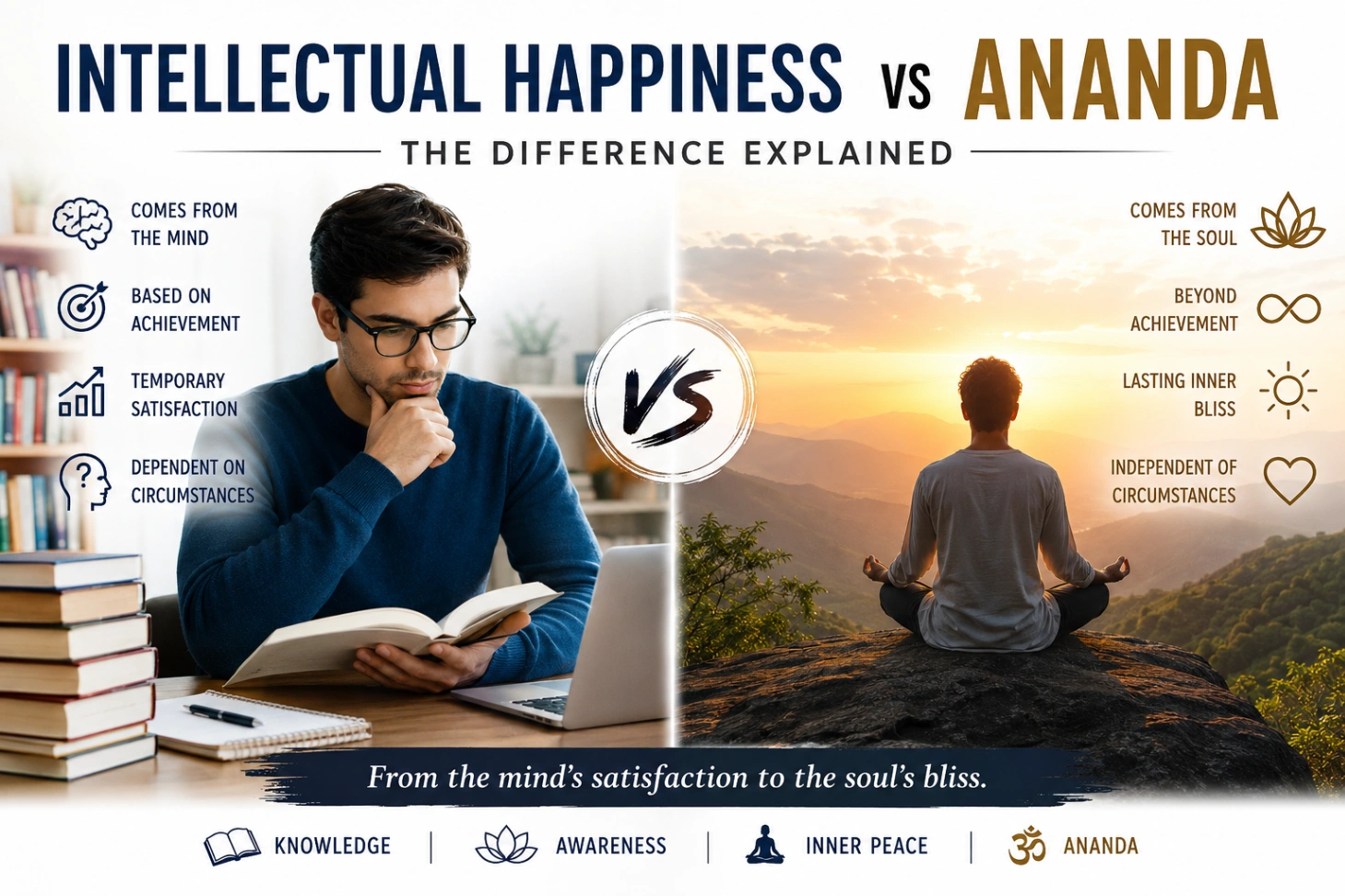
The core difference is simple. Intellectual happiness arises when the mind receives something it values. Ananda is recognised when we no longer depend completely on the mind to tell us whether we are enough.
Intellectual happiness says, “I understand this, so I feel good.” Ananda says, “Even before I understand everything, a deeper wholeness is available within me.” Intellectual happiness often depends on comparison: I know more, achieved more, or solved more. Ananda has no need to compare because it is not based on a personal scorecard.
Intellectual happiness can disappear when a new problem appears. Ananda does not mean problems disappear, but it can change our relationship with them. We become less reactive, less frightened by uncertainty, and less dependent on approval. This is why self-realization and bliss are often spoken of together. Self-realization is not becoming extraordinary in the eyes of the world. It is recognising the awareness present through every changing experience.
Why the Intellect Still Matters
Intelligence and spirituality do not need to be in conflict. The intellect is not the enemy of Ananda. A clear mind can help us ask better questions, examine our beliefs, and identify patterns that keep us trapped in suffering.
Yet the mind has a limit. It can explain bliss in Vedanta, discuss the Hindu concept of happiness, and analyse meditation, but it cannot replace direct inner experience. Intellectual understanding is often the beginning of the journey, not the final destination.
When knowledge becomes humble, it becomes useful. Instead of using ideas to feel superior, we can use them to become more present, compassionate, and honest. Then the intellect supports spiritual growth rather than becoming another source of ego.
How to Move From Temporary Happiness to Inner Bliss
The movement from intellectual satisfaction to deeper peace does not require abandoning ordinary life. It begins with awareness. Notice what your happiness depends on. Does it disappear when someone disagrees with you? Does it shrink when a plan fails? Does your sense of worth rely on being admired, productive, or right?
These questions are not meant to judge you. They reveal habits of the mind. A simple practice is to pause after a pleasant experience. Rather than immediately searching for the next stimulation, sit with gratitude. Observe the mind’s urge to hold on. This teaches us that joy is not something we can possess.
Meditation for inner peace can also help. You do not have to force the mind blank. Sit quietly, notice the breath, and allow thoughts to come and go without following each one. Over time, brief spaces between thoughts may reveal a quieter joy that does not need an achievement to justify it.
Service, self-reflection, devotion, and mindful action can also support this process. When we act without making every result a measure of our identity, work becomes lighter. We still give our best, but we do not lose ourselves in the outcome.

Can Meditation Lead to Lasting Happiness?
Many people ask whether meditation can lead to lasting happiness. Meditation does not promise a life without stress, sadness, or challenge. It can offer a different relationship with the mind. As we become more aware of thoughts and emotions, we are less likely to be carried away by every passing wave.
Joy in meditation may begin as calmness, clarity, or relief from mental noise. Some people describe a deeper ease that is not tied to a particular thought. In spiritual language, this can be understood as a glimpse of Ananda. The experience cannot be forced, and it should not become another achievement to chase.
The aim is not to collect peaceful moments, but to become available to the peace beneath the mind’s constant movement. This is where the journey from temporary happiness to spiritual happiness begins.
A More Complete Meaning of Happiness
What is real happiness? It is not the absence of desire, achievement, or enjoyment. It is the ability to participate fully in life without losing our centre. It is celebrating success without arrogance, facing failure without collapse, loving others without making them responsible for our inner emptiness, and working with dedication without constant fear.
When we understand happiness in this way, intellectual happiness finds its right place. Learning, creating, solving, and achieving remain beautiful expressions of life, but they are no longer the only door to joy. We begin to discover a spiritual happiness that is quieter, steadier, and less dependent on the world agreeing with our expectations.
Ananda is not a reward reserved for a perfect person. It becomes visible as we loosen our grip on the endless demand to be fulfilled by circumstances. The mind can bring us information. The awareness within can reveal inner peace. When both are used wisely, life becomes not an escape from the world, but a deeper way of living within it.
Personal Session
Seeking personal clarity on your inner journey, relationships, emotions, or life direction? Book a personal session and receive guidance that helps you understand your mind, reconnect with your inner peace, and move forward with greater awareness.
Book Now