
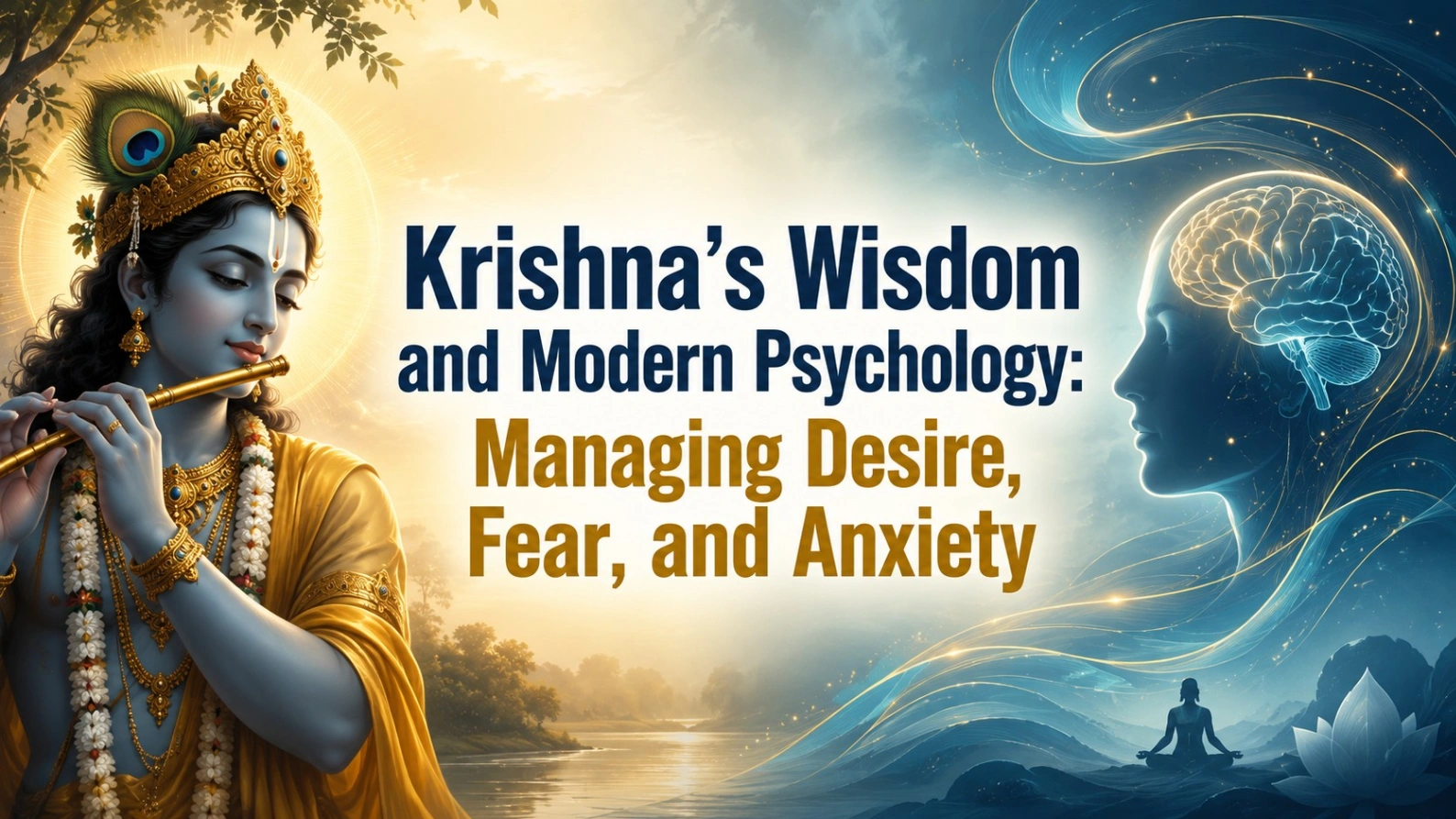
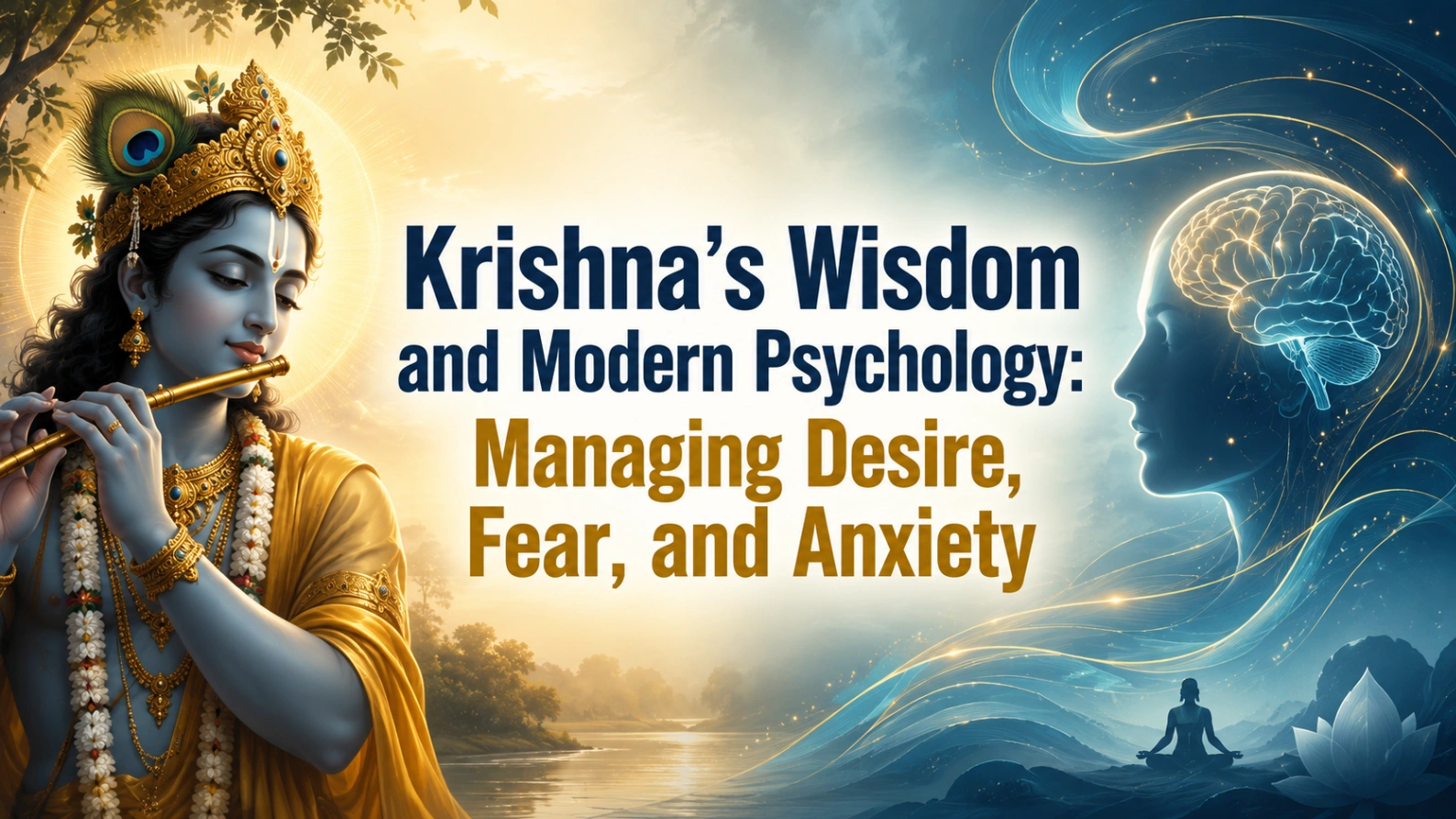
Krishna’s wisdom and modern psychology meet at one deeply human question: why does the mind become restless even when life looks normal from the outside? Desire pulls us toward what we want, fear warns us about what we could lose, and anxiety keeps replaying what could go wrong. The Bhagavad Gita does not treat these experiences as weakness. Through Krishna’s conversation with Arjuna, it offers a way to understand the mind, act with clarity, and return to inner peace.
Modern psychology speaks about rumination, emotional regulation, attachment, stress, and self-awareness. Bhagavad Gita teachings speak about attachment, desire, discipline, detachment, and equanimity. The words differ, but the concern is similar: how do we live wholeheartedly without allowing every thought, craving, fear, or outcome to control us?
Desire Is Not the Enemy, Attachment Is
Desire is natural. Wanting to grow, love, create, achieve, or improve your life can give direction and energy. The problem begins when desire becomes the condition for your peace. When the mind says, “I can only be happy when I get this job, person, recognition, money, or result,” desire becomes attachment.
In Bhagavad Gita 2.62–63, Krishna describes a sequence in which repeatedly dwelling on an object can become attachment, desire, frustration, anger, confusion, and loss of clear judgment. It is an observation that feels especially relevant today. The more attention we give to one outcome, the more power it gains over our mood and identity.
The psychology of desire and attachment often begins with attention. What we repeatedly compare, scroll through, imagine, or chase begins to feel essential. A promotion can become proof of worth. A relationship can become proof of lovability. A lifestyle can become proof of success. Krishna’s wisdom does not ask us to abandon aspiration. It asks us not to hand our inner peace over to what we cannot fully control.
Detachment in the Bhagavad Gita is often misunderstood. It does not mean becoming cold, passive, or indifferent. It means giving your best effort while staying emotionally free enough to accept that life has many variables. You can prepare sincerely for an interview and still not receive the offer. You can care deeply for someone and still not control their choices. You can work hard and still face delay. Detachment gives you room to respond rather than collapse.
Design Your Destiny
Your life does not need to be directed by fear, attachment, or overthinking. Design Your Destiny is an invitation to understand your inner patterns, reconnect with your deeper purpose, and learn spiritual tools for a calmer, more intentional life. Begin your journey toward clarity, courage, and inner peace today.
Start Your JourneyFear Begins Where Control Ends
Arjuna’s struggle is not presented as simple cowardice. He is overwhelmed by responsibility, grief, conflict, and the possible consequences of action. Krishna does not shame him for feeling disturbed. He helps him see more clearly. This matters for anyone asking how to overcome fear according to the Bhagavad Gita. Fear is not dissolved through denial. It is faced through clearer perception, a steadier identity, and meaningful action.
Anxious thinking often grows when the mind tries to predict and control uncertain outcomes. It creates scenarios, searches for reassurance, and rehearses disaster in the hope that preparation will create safety. Yet many fears are not solved by more thinking. They soften when we ground ourselves in what is true now and take the next useful step.
In Bhagavad Gita 2.47, Krishna directs attention toward action rather than complete ownership over results. This is a powerful answer to fear of failure. Your responsibility is to prepare, act ethically, learn, and persist. The result matters, but it cannot become the measure of your whole worth.
Anxiety and the Restless Mind
Anxiety can appear as racing thoughts, tension in the body, constant checking, irritability, sleeplessness, or a vague feeling that something is wrong. Bhagavad Gita teachings for a restless mind are meaningful because they do not pretend that the mind becomes calm simply because we order it to calm down.
In Chapter 6, the Gita presents the mind as capable of becoming both a friend and an obstacle. This is not a call to fight yourself. It is a reminder that habits of attention matter. The mind becomes more reactive when it is constantly fed comparison, overstimulation, fear, and unresolved emotion. It becomes more supportive when it is trained through reflection, discipline, rest, meaningful work, meditation, and mindfulness.
Krishna’s teachings on anxiety encourage us to change our relationship with thoughts. A fearful thought is not always a fact. A worst-case scenario is not always a prediction. An urge is not always an instruction. In modern psychology, this is close to observing a thought without automatically believing or obeying it. In spiritual psychology, it is the practice of witnessing the movement of the mind without losing your deeper centre.
This is why meditation can support emotional balance. It does not erase every problem, but it can create a pause between thought and reaction. Over time, that pause helps you recognise, “I am experiencing anxiety,” instead of “my anxiety is the whole truth.” That small shift can support mental peace.
Where Psychology and the Bhagavad Gita Meet
The connection between modern psychology and Bhagavad Gita teachings is not that one replaces the other. Psychology can offer practical tools for understanding behaviour, thinking patterns, relationships, and stress. Krishna’s wisdom adds a larger question: who are you beneath changing moods, roles, achievements, and fears?
This perspective can support emotional healing. It does not ask you to suppress disappointment or pretend pain does not matter. It asks you to hold pain without turning it into your permanent identity. You may have failed, but you are not only a failure. You may feel afraid, but you are not only fear. You may be uncertain, but uncertainty is not the entire meaning of your life.
For those exploring Bhagavad Gita and mental health, one distinction is important. Spiritual practices can support calm, self-awareness, and resilience, but they should not be used to dismiss serious distress. When anxiety feels intense, persistent, or difficult to manage, speaking with a qualified mental-health professional can be an important form of self-care. Seeking support can be part of spiritual growth.
How to Control Desire According to Krishna
Learning how to control desire according to Krishna does not mean punishing yourself for wanting things. It means noticing desire before it becomes compulsion. Ask: “Is this helping me grow, or making me dependent?” “Am I choosing this freely, or trying to escape discomfort?” “Would I still value this goal if nobody praised me for it?”
Return to action. Instead of asking, “Will this happen for me?” ask, “What is the most sincere action I can take today?” Instead of asking, “How do I make everyone approve of me?” ask, “How do I act in a way I respect?” This weakens anxiety and attachment.

Releasing Fear Without Avoiding Responsibility
Many people misunderstand detachment as an excuse to avoid difficult choices. Krishna teaches the opposite. Arjuna is not told to run from responsibility. He is encouraged to act with clarity, courage, and less attachment to personal fear. Detachment makes action cleaner because it reduces the noise of ego, panic, and constant self-protection.
Fear of failure according to the Bhagavad Gita becomes easier to face when success is not defined only as winning. Success is also the ability to act in alignment with your values, even when the outcome remains uncertain. You can apologise after a mistake, have a difficult conversation, apply for an opportunity, leave an unhealthy pattern, or ask for help. Courage is often a quiet decision to stop letting fear make every decision.
A Simple Practice for Inner Peace
Begin the day with a few quiet minutes before checking your phone. Notice the breath, reflect on a verse from the Bhagavad Gita, or ask, “What is truly within my control today?” When anxiety rises, pause before reacting. Name it kindly: “I am feeling afraid,” “I am attached to a result,” or “I am imagining a future that has not happened.” Then return to the next action within your control.
At night, reflect without judgment. Where did desire pull you away from peace? Where did fear stop you from acting? This strengthens self-awareness over time.
Living More Wisely With Desire, Fear, and Anxiety
The Bhagavad Gita does not promise a life without desire, fear, or uncertainty. It offers a wiser way to meet them. Desire can become direction without becoming bondage. Fear can become information without becoming paralysis. Anxiety can become a signal to pause, ground yourself, and seek support when needed.
Krishna’s wisdom and modern psychology both remind us that freedom does not come from controlling every circumstance. It comes from developing a steadier inner response. When you act with awareness, release excessive attachment to outcomes, and return to what is true within you, you begin to create the inner peace you have been searching for.

Personal Session
Looking for guidance that speaks directly to your present challenges? Book a personal session to explore the fears, desires, and thought patterns shaping your life, and receive compassionate spiritual direction for moving forward with greater clarity and confidence.
Book NowRead Latest Articles
Laughing Outside, Crying Within: A Spiritual Disconnect
Frequently Asked Questions
How does the Bhagavad Gita help with anxiety?
The Bhagavad Gita helps with anxiety by teaching us to focus on sincere action rather than trying to control every outcome. Krishna encourages self-awareness, discipline, and detachment from excessive fear and attachment. These ideas can help you observe anxious thoughts more calmly, return to the present moment, and choose the next action within your control.What does Krishna say about desire?
Krishna does not say that every desire is wrong. He teaches that desire becomes harmful when it creates attachment, frustration, anger, or loss of clarity. The aim is to act with purpose while remaining free from compulsive dependence on results.How can Krishna’s teachings help with fear of failure?
Krishna’s teachings shift attention from guaranteed results to right effort. You can prepare well, act sincerely, learn from setbacks, and continue moving forward without making one result the final judgment on your worth or future.What is the connection between Bhagavad Gita and modern psychology?
Both explore the mind, emotions, habits, self-awareness, and the effect of attachment on well-being. Psychology offers frameworks for understanding thoughts and behaviour, while the Bhagavad Gita offers spiritual guidance on identity, purposeful action, and inner freedom.Can meditation help with overthinking?
Meditation can create a pause between thoughts and reactions. It may help you notice overthinking without automatically following every worry. It works best as a regular practice and can be paired with professional support when anxiety feels persistent or overwhelming.