
Imagine your mind is a busy highway. Thoughts are like cars speeding by some are loud trucks carrying heavy worries, others are fast sports cars of anxious "what-ifs," and some are just repetitive commuters of daily tasks.
Now, imagine you are standing in the middle of this highway, trying to stop every car, argue with every driver, or hitch a ride in every vehicle. What happens? Chaos, exhaustion, and anxiety. This is the state of the modern mind; a constant barrage of racing thoughts, rumination, and mental exhaustion. We are desperate to know how to stop overthinking.
But what if you didn’t have to stand on the highway? What if you could stand on a bridge above it, calmly watching the traffic flow beneath you, untouched by the noise?
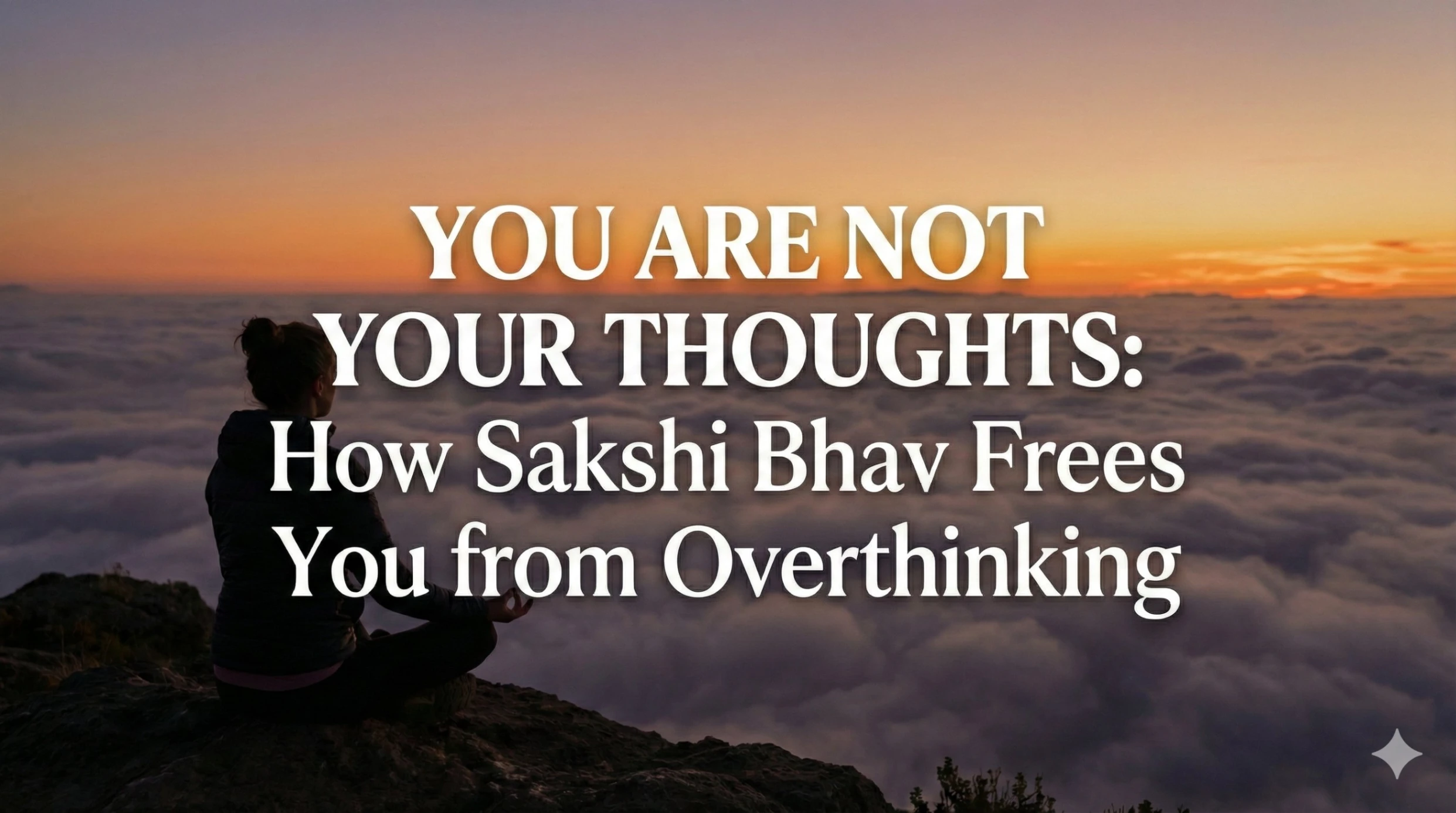
This shift in perspective is the essence of ancient wisdom known as Sakshi Bhav, or Witness Consciousness. It is the ultimate key to anxiety relief and the realization of a profound truth: You are not your thoughts.
The Trap of the "Monkey Mind"
Why do we overthink? According to ancient spiritual psychology, the human mind is composed of layers. We often get stuck in the layer of Vichara (intellect and thought).
The mind’s nature is to generate thoughts, much like a monkey’s nature is to jump from branch to branch. This "monkey mind" is constantly analyzing, judging, replaying the past, and fearing the future. The problem isn't that we have thoughts; the problem is our identification with them.
When an intrusive thought says, "I am not good enough," we don't just hear it; we believe it. We say, "This is my thought," and we claim it as our reality. We become entangled in the traffic. This constant engagement with mental noise leads to severe mental exhaustion and blocks our path to true mental wellness and inner peace.
We spend our lives trying to control thoughts through sheer willpower, which is often as effective as trying to hold back the ocean waves with a broom.
The Paradigm Shift: What is Sakshi Bhav?
Sakshi Bhav is the game-changer. It is the cornerstone of true mindfulness and spiritual growth.
Sakshi means "witness," and Bhav means "state" or "attitude." It is the state of being an impartial observer of your own inner world. It is the realization that if you can observe a thought, you cannot be that thought. The observer is always separate from the observed.
Think of the sky and the clouds. Clouds (thoughts and emotions) come and go; they can be dark, stormy, or fluffy. But the sky (your true consciousness) remains untouched, vast, and permanent. Sakshi Bhav is shifting your identity from the passing clouds back to the eternal sky.
This is not about numbing yourself or forcing a "positive mindset." It is about emotional detachment; a healthy separation where you allow thoughts to exist without getting kidnapped by them.
The Observer Effect in Mental Health
In modern terms, this is similar to the "observer effect" in psychology. When you step back and observe your anxiety without judging it, you change its nature. By simply watching rumination without participating in it, you starve the thoughts of the energy they need to survive. You stop fueling the fire.
How Sakshi Bhav Stops Overthinking
The ancient teachings derived from sources like the Bhagavad Gita suggest that we are trapped in the layers of action (karma), emotion (bhav), and thought (vichara). The only way out is not through more thinking, but through the backdoor of meditation and witnessing.
When you practice Sakshi Bhav, a profound shift occurs:
You Break the Loop: Overthinking is a loop of repetitive thoughts. Witnessing creates a wedge in that loop. You see the thought arise, but instead of following it down the rabbit hole, you let it pass.
De-identification: You realize that thoughts are just mental events, like confetti popping in the brain. They are not facts. This is crucial for learning how to detach from negative thoughts.
Finding the Gap: This is the secret sauce. When you consistently observe your thoughts, you begin to notice something incredible: a tiny micro-second of silence between one thought ending and the next one beginning.
That "gap" is your gateway to mental clarity and spiritual awakening. In that gap, there is no anxiety, no past, and no future. There is only pure existence.
Practical Meditation Tips for Anxiety Relief
How do we move from understanding this intellectually to experiencing it? We need practical meditation tips to cultivate Witness Consciousness.
Drawing from ancient wisdom, here is a simple yet powerful practice to quiet the mind:
The 10-Minute Witnessing Exercise
This is a direct method to experience that you are not your thoughts.
Sit Comfortably: Find a quiet spot. Close your eyes. Take a few deep breaths to settle the body.
Become the Watchman: Imagine you are a watchman at the gate of your mind. Your job is simply to watch who comes in and who goes out.
Observe the Traffic: Let thoughts come. Do not try to stop them. Do not judge them as "good" or "bad." If a worried thought comes, note it: "Ah, a worried thought." If a planning thought comes, note it: "Planning is happening."
Remain Detached: The crucial part is emotional detachment. Do not get involved in the story the thought is telling. If you find yourself carried away by a thought train (which will happen), gently smile and return to your post as the watchman.
Notice the Transience: Observe how thoughts arise from nowhere and dissolve back into nowhere. They are impermanent. Why base your identity on something so fleeting?
If you practice this for just 10 minutes a day for 21 days, you will notice a significant decrease in the intensity of racing thoughts. You will find that the "gap" of silence between thoughts begins to widen, bringing profound anxiety relief.
From Mental Exhaustion to Inner Peace
Overcoming overthinking is not about achieving a perfectly silent mind where no thoughts ever appear. It is about changing your relationship with your thoughts.
When you live in Sakshi Bhav, you become like a hollow bamboo, an instrument through which life flows freely, without the blockage of constant mental chatter. You still think when necessary, but you are no longer used by your thoughts.
By embracing the truth that you are not your thoughts, you step out of the chaotic traffic of the monkey mind and onto the bridge of higher consciousness. This is the path to lasting mental wellness and the ultimate freedom of inner peace.