
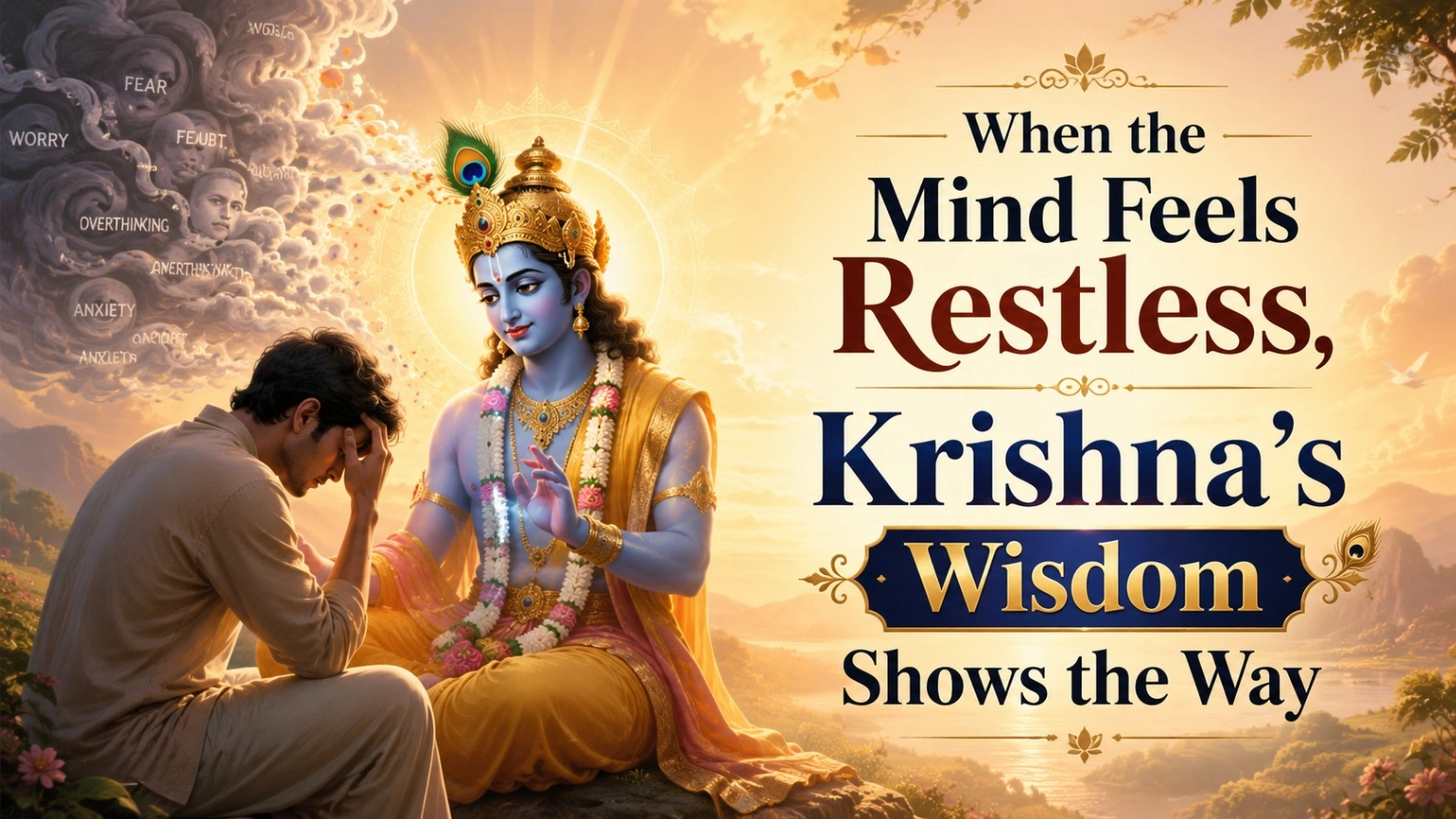
There are moments when the mind feels like a storm. One thought leads to another, worries keep repeating, emotions become heavy, and even simple decisions feel confusing. In such times, the Bhagavad Gita teachings for mind control offer a timeless path toward peace, clarity, and inner strength. Krishna’s wisdom does not ask us to run away from life. It teaches us how to live with awareness, how to control the restless mind, and how to remain calm even when situations outside us keep changing.
The beauty of Lord Krishna’s teachings is that they are deeply spiritual, yet very practical. The Bhagavad Gita speaks to every person who has ever felt anxious, overthinking, emotionally disturbed, or mentally tired. It shows that the mind can either become our best friend or our biggest challenge, depending on how we train it.
Today, when people are constantly surrounded by distractions, pressure, comparison, expectations, and emotional stress, Krishna’s wisdom for peace of mind feels more relevant than ever. The Gita reminds us that peace is not found by controlling the whole world. Peace begins when we learn how to understand and guide our own mind.
Why Does the Mind Feel So Restless?
A restless mind is not something new. Even Arjuna, the great warrior in the Bhagavad Gita, experienced confusion, fear, emotional conflict, and mental disturbance. He stood in the middle of a difficult situation and felt overwhelmed. His hands trembled, his thoughts became unclear, and he could not decide what was right.
This is why the Gita feels so human. It does not present Arjuna as weak. It shows him as someone deeply sensitive, thoughtful, and emotionally affected by life’s challenges. In the same way, our mind becomes restless when we are attached to outcomes, afraid of failure, stuck in overthinking, or unable to accept change.
The restless mind keeps moving between the past and the future. It remembers what went wrong, imagines what could go wrong, and forgets the present moment. Krishna teaches that this movement of the mind can be controlled through self-awareness, discipline, detachment, and spiritual wisdom.
CTA for Design Your Destiny
Ready to move from a restless mind to a peaceful life? Join the Design Your Destiny program and learn how to apply Krishna’s wisdom, spiritual discipline, self-awareness, and inner transformation practices in your daily life. Start creating a life guided by clarity, balance, and divine purpose.
Start Your JourneyWhat Krishna Teaches About the Mind
One of the most powerful Krishna teachings on mind is that the mind must be trained with patience. Krishna does not say that controlling the mind is easy. He acknowledges that the mind is restless, powerful, and difficult to control. But he also says that through practice and detachment, it can be mastered.
This is an important lesson. Many people feel guilty when their mind wanders during meditation or when they struggle with negative thoughts. But the Bhagavad Gita gives a compassionate view. It tells us that the mind naturally moves, but we can gently bring it back.
Mind control does not mean forcefully suppressing thoughts. It means becoming aware of thoughts without becoming a slave to them. It means noticing anger without acting blindly, observing fear without collapsing, and watching overthinking without believing every thought.
Krishna’s wisdom shows us that the mind becomes peaceful when it is guided by higher understanding.
The Mind Can Be a Friend or an Enemy
A key Bhagavad Gita lesson for mental peace is that the mind can either uplift us or pull us down. When the mind is disciplined, it becomes a friend. It helps us focus, make better choices, stay emotionally balanced, and move toward spiritual growth. But when the mind is uncontrolled, it becomes an enemy. It creates fear, anger, attachment, jealousy, confusion, and unnecessary suffering.
This teaching is very relevant in modern life. For example, two people may face the same situation, but their inner response may be completely different. One person may react with panic, while another may pause, reflect, and respond calmly. The difference lies in the training of the mind.
Krishna’s wisdom for emotional balance teaches us to become the master of our inner world. We may not always control what happens outside, but we can slowly learn to control how we respond inside.
How to Control a Restless Mind According to Krishna
The Bhagavad Gita does not offer a quick trick for peace of mind. It offers a complete way of living. If you want to know how to control restless mind according to Krishna, the answer begins with awareness.
The first step is to observe your thoughts. Most people are so identified with the mind that they believe every thought is true. If the mind says, “I will fail,” they feel defeated. If the mind says, “Nobody understands me,” they feel lonely. If the mind says, “Something bad will happen,” they become anxious.
Krishna’s teachings help us create distance from these thoughts. You can notice the thought, but you do not have to become the thought. This simple shift creates inner calm.
The second step is practice. A peaceful mind is not built in one day. Just as the body becomes strong through regular exercise, the mind becomes steady through daily discipline. Meditation, prayer, chanting, self-reflection, mindful action, and reading spiritual wisdom can slowly train the mind.
The third step is detachment. Detachment does not mean you stop caring. It means you act sincerely without becoming mentally trapped by the result. This is one of the most powerful spiritual ways to control thoughts.
Krishna’s Wisdom for Overthinking
Overthinking happens when the mind tries to control everything. It wants certainty before taking action. It wants guarantees before trusting life. It keeps asking, “What if this goes wrong?” or “What will people think?” or “Why did this happen to me?”
Bhagavad Gita for overthinking teaches a different approach. Krishna reminds us to focus on our duty, our action, and our intention, rather than becoming obsessed with the outcome. This does not mean results do not matter. It means we should not allow results to destroy our peace.
When you do your best with sincerity and surrender the result, the mind becomes lighter. You stop carrying the burden of controlling everything. You begin to trust the process of life.
This is why karma yoga is such a powerful teaching. Karma yoga means performing your actions with dedication, without selfish attachment to the fruits of those actions. It is not passive. It is deeply active, but peaceful.

Detachment: The Secret to Inner Peace
Many people misunderstand detachment. They think it means becoming emotionless or distant. But in Krishna’s wisdom, detachment means freedom from unhealthy attachment. It means loving without possession, working without ego, and living without constant fear of loss.
A restless mind is often restless because it is attached. It is attached to praise, success, relationships, comfort, identity, and approval. When any of these feel threatened, the mind becomes disturbed.
The Gita teachings for inner peace guide us to remain balanced in success and failure, pleasure and pain, gain and loss. This balance does not come from indifference. It comes from spiritual maturity.
When we understand that life keeps changing, we stop expecting permanent security from temporary things. This understanding brings mental peace.
Meditation and Mindfulness in Krishna’s Teachings
Meditation is one of the most effective mind control techniques mentioned in spiritual traditions. In the Bhagavad Gita, meditation is connected with discipline, focus, self-control, and inner awareness.
To calm the mind spiritually, you can begin with a simple practice. Sit quietly for a few minutes. Close your eyes. Observe your breath. Let thoughts come and go. Do not fight them. Do not judge them. Just watch.
This practice slowly builds self-awareness. You begin to realize that you are not the noise of the mind. You are the awareness behind it.
Mindfulness in daily life can also become a form of meditation. When you eat, eat with awareness. When you speak, speak with awareness. When you work, work with focus. When emotions arise, pause before reacting. This is how spiritual growth becomes part of ordinary life.
Krishna Consciousness and Surrender
Krishna consciousness is not only about rituals. It is a state of remembering the divine presence in life. It means living with devotion, awareness, humility, and surrender.
Surrender to Krishna does not mean giving up responsibility. It means giving up ego-based anxiety. It means saying, “I will do my duty sincerely, but I will not let fear control me.” This kind of surrender brings deep inner strength.
When the mind feels restless, surrender becomes a powerful medicine. You stop fighting every situation alone. You begin to feel supported by a higher wisdom.
This is why chanting, prayer, and devotion can bring emotional healing. They shift the mind from fear to faith, from confusion to clarity, and from restlessness to peace.

Emotional Control Through Spiritual Wisdom
Emotional control does not mean hiding emotions. It means understanding them. Krishna’s teachings encourage us to rise above impulsive reactions. Anger, fear, jealousy, and sadness are part of human experience, but they do not have to control our actions.
When you are angry, pause. When you are afraid, breathe. When you are confused, reflect. When you are hurt, observe before reacting. These small practices create a disciplined mind.
The more you practice self-control, the more mental clarity you develop. You begin to respond from wisdom rather than impulse. This is the foundation of emotional balance.
How Krishna’s Teachings Help in Stress and Anxiety
Bhagavad Gita for stress and anxiety works because it addresses the root of inner disturbance. Stress often comes from attachment to outcomes, fear of the future, comparison with others, and lack of inner grounding.
Krishna’s wisdom helps us return to what is in our control. Our actions, intentions, discipline, values, and attitude are within our control. Other people’s opinions, unexpected results, and changing circumstances are not fully in our control.
When we understand this difference, the mind becomes calmer. We stop wasting energy on what we cannot control and begin using our energy wisely.
This is not just spiritual philosophy. It is a practical way to live with less mental pressure.
Daily Practices to Calm a Restless Mind
If you want to apply Lord Krishna teachings for a peaceful mind, start with small daily steps.
Begin your morning with a few minutes of silence. Read one verse or teaching from the Bhagavad Gita and reflect on it. Practice mindful breathing whenever stress rises. Before reacting to a difficult situation, pause and ask, “Am I responding from wisdom or from restlessness?”
You can also practice gratitude. A restless mind focuses on what is missing. A grateful mind notices what is already present. Gratitude shifts attention from lack to abundance.
Another helpful practice is selfless action. Do something good without expecting recognition. This reduces ego and opens the heart.
These simple habits can gradually transform your inner state.

When the Mind Feels Restless, Remember This
The mind will not become peaceful by force. It becomes peaceful through understanding, practice, and surrender. Krishna’s wisdom does not promise a life without challenges. It teaches us how to remain steady within challenges.
When thoughts are loud, return to awareness. When emotions are heavy, return to breath. When outcomes feel uncertain, return to action. When life feels overwhelming, return to Krishna’s wisdom.
The path of mind control is not about becoming perfect. It is about becoming conscious. It is about learning to pause, observe, choose, and surrender.
The Bhagavad Gita teaches that peace is not somewhere far away. It is available within us when the mind becomes disciplined, the heart becomes humble, and the soul remembers its connection with the divine.
So when the mind feels restless, Krishna’s wisdom truly shows the way. It guides us from overthinking to clarity, from fear to faith, from attachment to freedom, and from inner chaos to lasting peace.
CTA for Personal Session
If your mind feels restless, confused, or emotionally overwhelmed, book a personal session for deeper guidance. Get practical spiritual tools, personalized clarity, and step-by-step support to calm your mind, strengthen your inner balance, and reconnect with your true self.
Book Now