

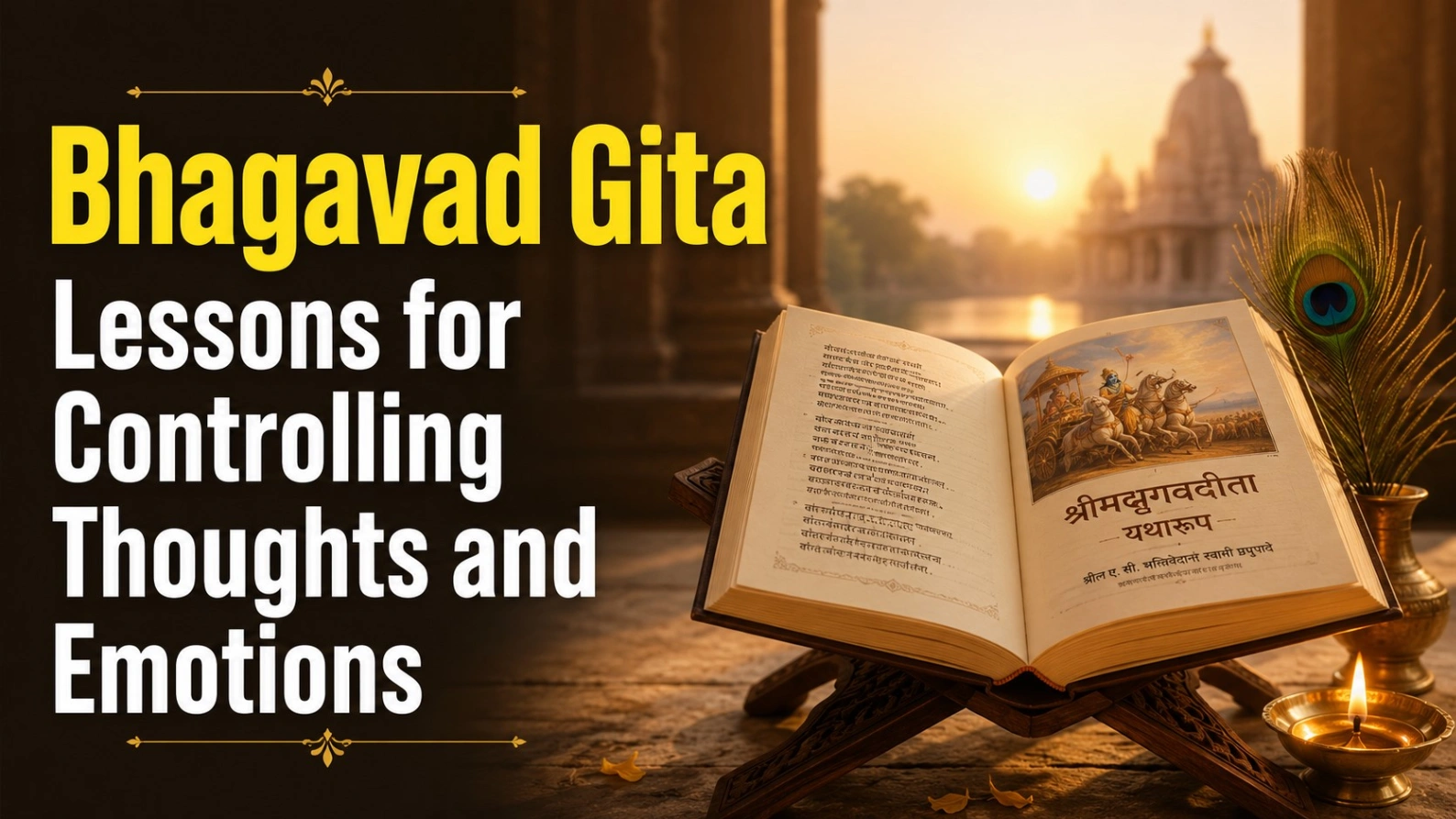
The mind can be our greatest source of strength, but it can also become the cause of stress, fear, anger and confusion. The Bhagavad Gita lessons on the mind offer practical guidance for anyone who wants to understand how to control thoughts and emotions without suppressing them.
Spoken by Lord Krishna to Arjuna during a moment of intense emotional conflict, the Bhagavad Gita is not simply a religious text. It is also a guide to self-control, mental peace, emotional balance and spiritual growth.
Arjuna’s struggle is deeply relatable. He feels overwhelmed, uncertain and emotionally unable to act. Instead of asking him to ignore his emotions, Krishna helps him understand their source. The teachings show that lasting peace does not come from controlling every external situation. It comes from learning how to manage the mind that interprets those situations.
Here are some of the most important Bhagavad Gita teachings for controlling thoughts and emotions.
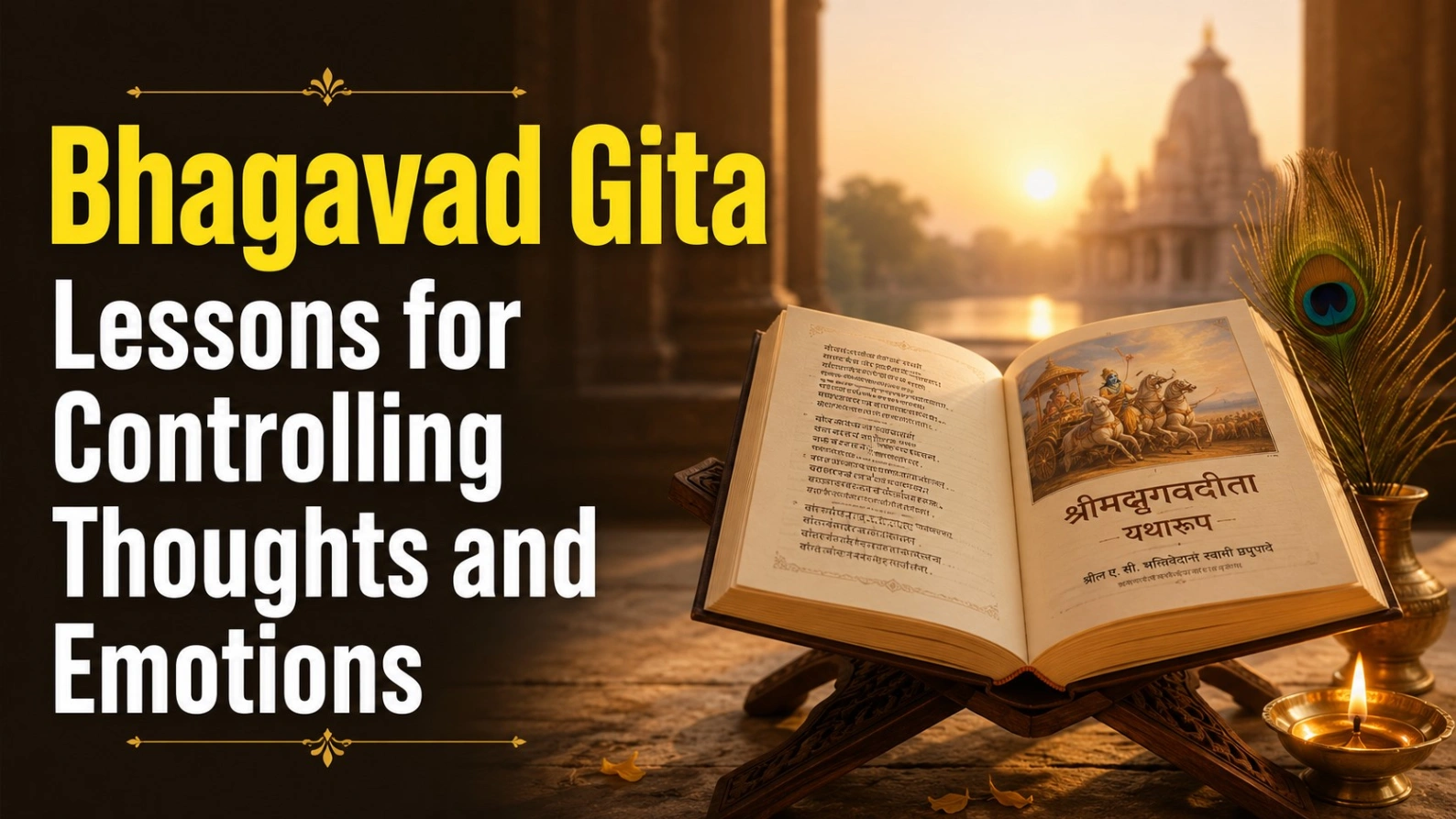
Why Is the Mind So Difficult to Control?
In Chapter 6 of the Bhagavad Gita, Arjuna describes the mind as restless, powerful and difficult to control. His concern is familiar to anyone who has tried to stop overthinking, remain focused during meditation or stay calm during an argument.
A thought enters the mind, creates an emotional response and soon influences our words and actions. Before we realize it, one negative thought may turn into anxiety, anger, jealousy or fear.
Krishna does not deny that the mind is difficult to manage. He acknowledges the challenge and explains that it can be disciplined through two essential practices: consistent effort and detachment.
This is one of the most practical Krishna teachings on mind control. Mental discipline is not created through force. It develops gradually when we practise awareness and stop feeding every thought with attention.
Design Your Destiny
Your thoughts shape your decisions, habits and direction in life. The Design Your Destiny program helps you understand the deeper patterns influencing your mind and teaches practical methods for developing clarity, emotional balance and conscious action. Move beyond overthinking, fear and emotional confusion. Begin creating your life with awareness and purpose
Start Your Journey Today!1. Understand That the Mind Can Be a Friend or an Enemy
In Bhagavad Gita Chapter 6, verses 5 and 6, Krishna explains that the mind can become a person’s friend when it is disciplined and an enemy when it remains uncontrolled.
An uncontrolled mind reacts automatically. It follows fear, desire, anger and social pressure. A disciplined mind creates space between an emotion and a reaction.
For example, anger may still arise, but you do not immediately speak harshly. Anxiety may appear, but you do not automatically believe every fearful prediction. This pause is the beginning of self-control.
If you want to understand how to control your mind according to the Bhagavad Gita, begin by observing whether your thoughts are supporting your growth or weakening your inner stability.
Ask yourself:
Is this thought based on reality or fear?
Is it helping me act wisely?
Am I responding consciously or reacting emotionally?
Will this thought matter after a few days?
You cannot prevent every thought from appearing, but you can decide which thoughts deserve your attention.
2. Practise Abhyasa: Train the Mind Consistently
Krishna recommends abhyasa, or repeated practice, as a method for training the restless mind.
Mental control is not achieved through one meditation session or one positive thought. It develops through regular practice. Every time the mind wanders and you gently bring it back, you strengthen your ability to direct your attention.
This principle can be used in meditation and everyday life.
When you notice yourself overthinking, return your attention to the present task. When anger appears, return to your breathing before responding. When fear creates imaginary outcomes, return to what you can realistically do now.
The goal is not to create a mind that never wanders. The goal is to become capable of bringing it back.
This is why Bhagavad Gita meditation is closely connected with self-control. Meditation gives you an opportunity to observe thoughts instead of immediately identifying with them.
Begin with five to ten minutes a day. Sit comfortably, notice your breathing and observe the thoughts that arise. When attention wanders, gently return to the breath without criticizing yourself.
3. Develop Vairagya: Stop Clinging to Every Thought
Along with practice, Krishna recommends vairagya, commonly understood as detachment.
Detachment does not mean becoming cold, uncaring or disconnected from life. It means refusing to let every thought, desire or emotional experience control you.
Suppose someone criticizes you. The mind may repeatedly replay the conversation, imagine new arguments and create emotional pain long after the incident has ended. Detachment allows you to observe the experience without continuing to carry it.
You may reflect on whether the criticism contains something useful. After learning from it, you release the unnecessary emotional burden.
This is one of the most valuable Bhagavad Gita lessons for modern life. We often suffer not only because of what happened, but because the mind continues holding, repeating and exaggerating it.
Detachment helps us participate fully in life without allowing every outcome to determine our inner peace.
4. Break the Chain of Thought, Attachment and Anger
Bhagavad Gita Chapter 2, verses 62 and 63, describes how repeated contemplation can create attachment. Attachment may produce desire, and frustrated desire can turn into anger. Anger then clouds judgment and weakens our ability to make wise decisions.
This sequence explains why some emotions appear to become stronger over time.
A single thought may seem harmless. However, when we repeatedly focus on it, the thought receives emotional energy. It becomes an expectation. When reality does not match that expectation, frustration begins.
To break this chain, become aware of repetitive thinking early.
When you notice the mind obsessing over a person, result or situation, pause and ask:
Am I creating an unrealistic expectation?
Am I depending on this outcome for my happiness?
What will happen if events unfold differently?
Can I give my best effort without becoming mentally attached?
This awareness is particularly helpful for anyone searching for Bhagavad Gita teachings on anger, desire and emotional control.

5. Focus on Action Instead of Becoming Anxious About Results
One of the most widely known Bhagavad Gita teachings is to perform your duty without becoming attached to the result.
This does not mean that goals are unimportant. It means that we should not allow an uncertain result to dominate our mind.
Many forms of anxiety come from mentally living in the future. We imagine failure, rejection, embarrassment or disappointment before anything has happened. The mind becomes exhausted by outcomes it cannot completely control.
Krishna’s teaching redirects attention toward action.
A student cannot fully control an examination result, but can control preparation. A professional cannot control every business outcome, but can control the quality of the work. A person cannot control how others behave, but can control their own response.
When attention returns to present action, worry loses some of its power. This is why the Bhagavad Gita for stress and anxiety remains relevant in modern life.
Do what is required with sincerity. Prepare carefully. Act responsibly. Then release the need to control everything that follows.
6. Accept That Pleasure and Pain Are Temporary
In Chapter 2, Krishna explains that experiences such as pleasure, pain, heat and cold are temporary. They arise and pass away.
Emotions also change. A feeling that appears overwhelming today may become much weaker with time. Remembering this prevents us from making permanent decisions during temporary emotional states.
When sadness appears, do not assume it will last forever. When anger appears, do not treat it as a command to act. When success brings excitement, enjoy it without believing that the feeling defines your worth.
The ability to tolerate temporary discomfort is an important part of emotional strength.
Instead of saying, “I am angry,” try saying, “Anger is present right now.”
Instead of saying, “I am anxious,” say, “I am experiencing anxiety.”
This small shift creates distance between your identity and your emotions. You begin to understand that you are the observer of an emotion, not the emotion itself.
7. Control the Senses to Calm the Mind
The Bhagavad Gita explains that the senses constantly pull the mind toward external objects and experiences. What we repeatedly watch, hear and consume influences the quality of our thoughts.
If your day begins with disturbing news, comparison-driven social media and constant notifications, the mind naturally becomes restless. Attempting to find mental peace without changing these inputs can be difficult.
Controlling the senses does not require completely withdrawing from the world. It means becoming more selective.
Consider limiting:
Unnecessary social media scrolling
Content that repeatedly triggers anger or fear
Conversations based on gossip and negativity
Constant notifications and digital distractions
Environments that encourage unhealthy habits
Replace them with reading, meditation, meaningful conversations, physical movement and quiet reflection.
This is a practical form of Bhagavad Gita self-control. A peaceful mind becomes easier to develop when it is not constantly disturbed by unhealthy stimulation.
8. Maintain Balance in Daily Life
Krishna advises balance in eating, sleeping, working and recreation. Excess in any area can disturb the mind.
A person who sleeps too little may become emotionally reactive. Someone who works continuously without rest may struggle with irritability and anxiety. Excessive stimulation may make meditation difficult, while complete inactivity may encourage dullness.
Spiritual growth does not require neglecting the body or daily responsibilities. A disciplined lifestyle supports a disciplined mind.
Try to create balance through:
Consistent sleeping and waking times
Moderate and mindful eating
Regular physical activity
Time for meditation or silence
Focused periods of work
Healthy rest and recreation
These habits may appear simple, but they strongly influence emotional balance and mental clarity.

9. Become a Witness to Your Thoughts
Many people try to control thoughts by fighting them. This often makes the thoughts stronger.
A more effective approach is to observe them.
Imagine thoughts as clouds moving across the sky. Some are pleasant, while others are dark and uncomfortable. The sky does not chase or resist them. It allows them to pass.
Similarly, you can observe a negative thought without accepting it as truth.
A thought may say, “I will fail.” Instead of arguing with it, notice: “The mind is producing a fear-based thought.”
This practice weakens automatic identification. Over time, the mind becomes less capable of pulling you into every story it creates.
Such awareness supports mindfulness, meditation, emotional healing and positive thinking without forcing artificial positivity.
10. Respond from Wisdom Rather Than Emotion
The Bhagavad Gita does not ask us to eliminate emotions. Emotions provide information, but they should not become the only basis for action.
Arjuna’s emotions were real, but Krishna encouraged him to examine the situation with greater wisdom. Similarly, we can acknowledge what we feel while deciding how to act consciously.
Before making an emotionally charged decision, pause and consider:
What am I feeling?
What triggered this feeling?
What action does the emotion want me to take?
What would a calm and wise response look like?
Will I respect this decision tomorrow?
This pause connects emotional awareness with discrimination and wisdom.

A Simple Daily Practice for Mental and Emotional Control
Use this five-step practice whenever the mind becomes disturbed:
Pause: Do not react immediately.
Breathe: Take five slow, conscious breaths.
Observe: Identify the thought and emotion without judgment.
Examine: Ask whether the thought is factual, useful and within your control.
Act: Choose the response that reflects your values rather than your temporary emotional state.
Practised regularly, these steps can help transform Krishna’s teachings from philosophy into daily experience.
The Bhagavad Gita does not promise that difficult thoughts and emotions will disappear completely. Instead, it teaches us how to stop becoming their helpless followers.
Through practice, detachment, disciplined action, balanced living and self-awareness, the mind gradually becomes more stable. Anger may arise, but it does not have to control your speech. Fear may appear, but it does not have to stop your progress. Thoughts may wander, but you can repeatedly bring them back.
The deepest lesson is that mastering the mind is not about force. It is about understanding.
When you learn to observe thoughts, release attachment and focus on purposeful action, the mind slowly becomes your friend. That is the foundation of mental peace, emotional balance and spiritual growth.
Personal Session
Every person experiences a different emotional and spiritual struggle. A personal session gives you the space to understand the thoughts, fears, attachments and behavioural patterns that may be preventing you from experiencing peace. Receive personalised spiritual guidance, practical clarity and support suited to your present situation. Book a personal session today and begin your journey toward mental peace, emotional freedom and deeper self-awareness.
Book Now