

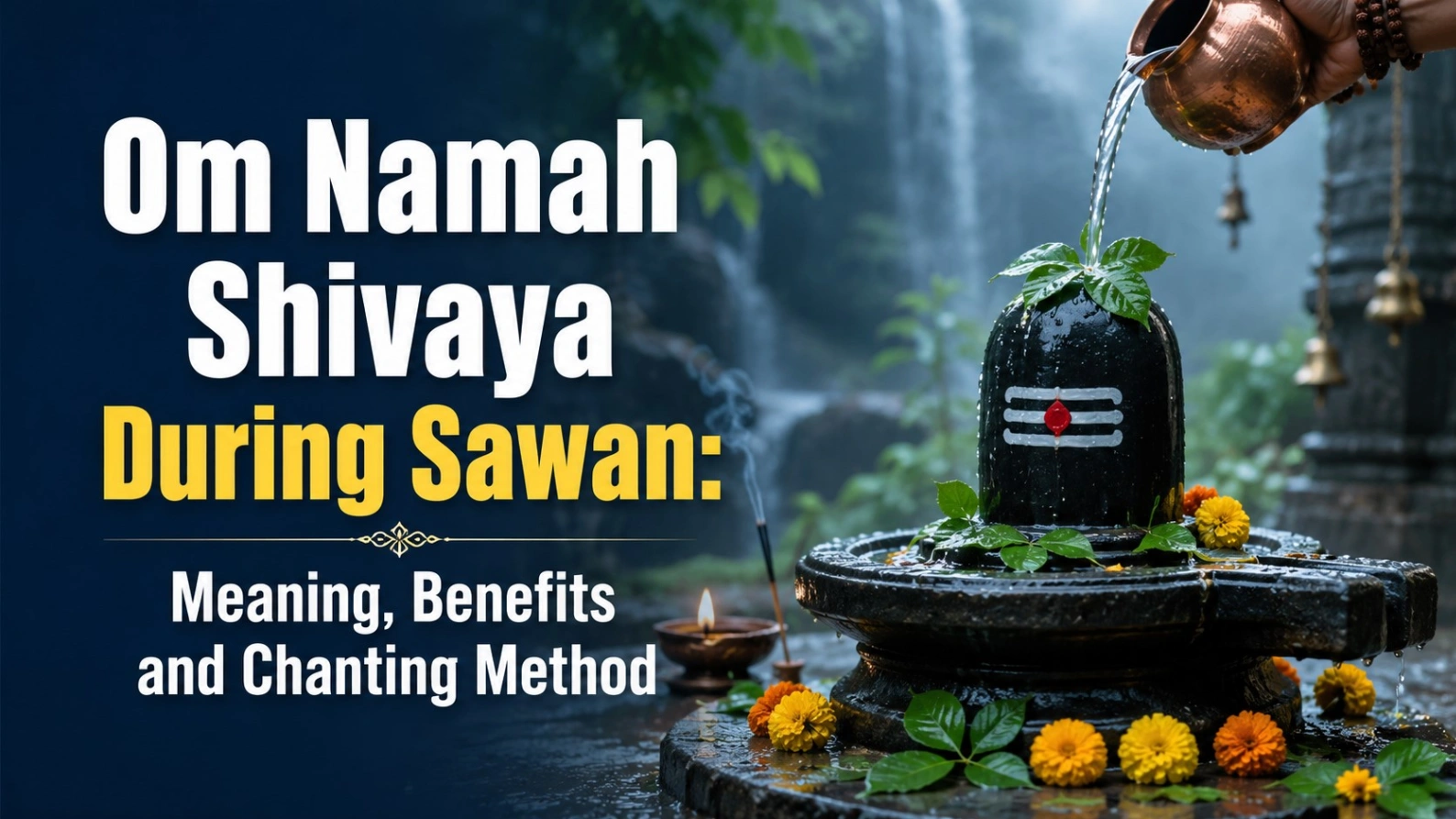
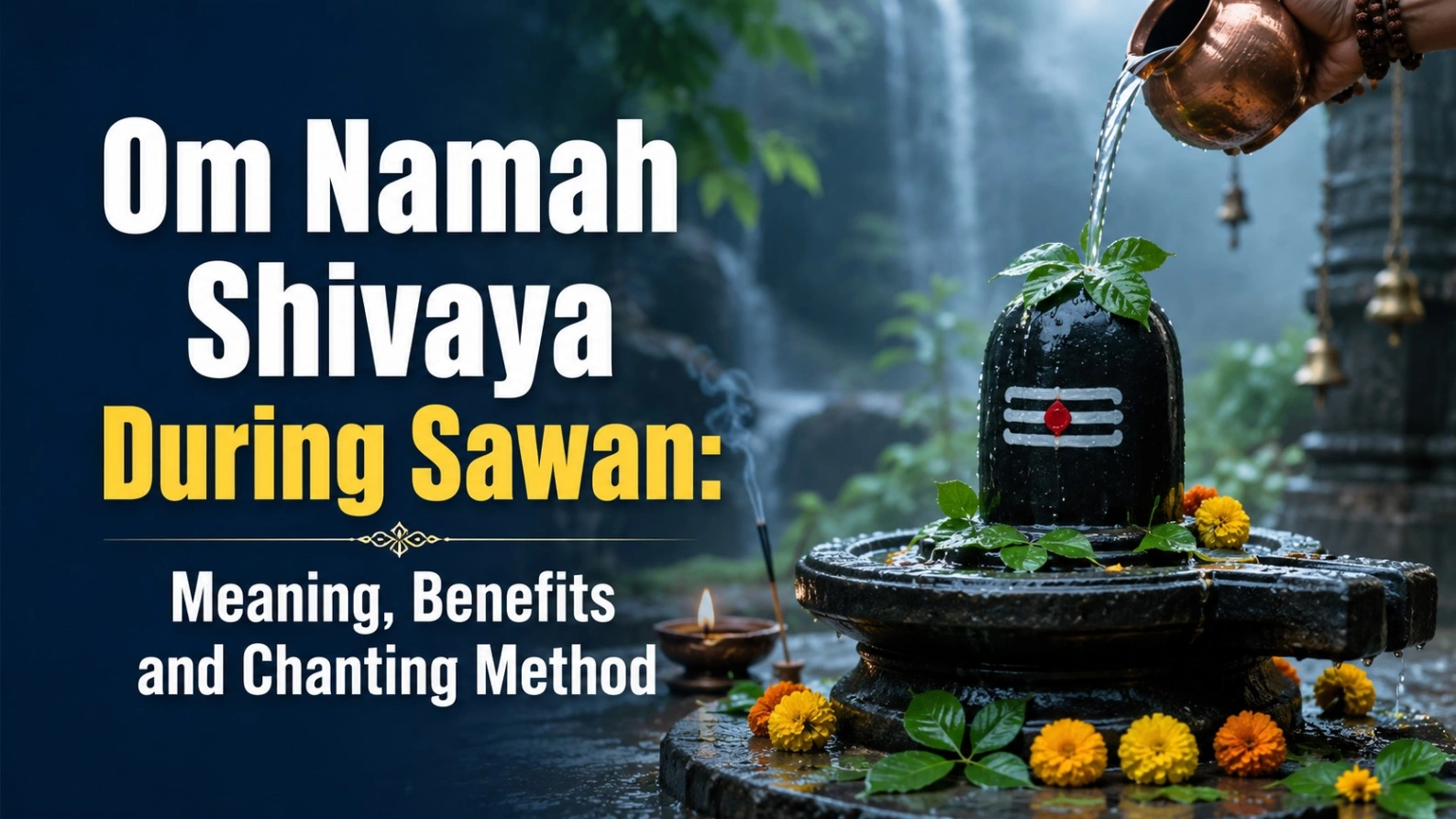
Om Namah Shivaya during Sawan is one of the most widely followed spiritual practices among devotees of Lord Shiva. During this sacred month, temples fill with the sound of Shiva mantras, devotees observe Sawan Somwar vrat, and many people begin a daily practice of chanting Om Namah Shivaya.
The mantra is simple enough for a beginner to remember, yet its meaning carries deep spiritual significance. It is not merely a request for material blessings. It is traditionally understood as an expression of surrender, reverence and connection with the higher consciousness represented by Lord Shiva.
But what does Om Namah Shivaya mean? Why is it chanted during Sawan, and is there a correct chanting method? Let us understand the mantra, its benefits, rules and daily practice in a clear and practical way.
Sawan 2026 Dates and Regional Differences
In 2026, the Purnimanta Sawan month followed across many North Indian states begins on July 30, 2026, and ends on August 28, 2026. The four Sawan Somwar dates in this calendar are August 3, August 10, August 17 and August 24.
The Amanta Shravan calendar followed in states including Maharashtra, Gujarat, Goa, Karnataka, Andhra Pradesh and Telangana begins on August 13, 2026, and ends on September 11, 2026. Regional dates differ because various parts of India follow different lunar and solar calendar systems. Devotees should therefore confirm important dates using the Panchang followed in their location.
Design Your Destiny
Knowing a mantra is only the beginning. Real transformation happens when spiritual wisdom becomes part of your thoughts, decisions and everyday actions. Join Design Your Destiny to discover practical tools for self-awareness, conscious living and inner transformation. Learn how to move beyond limiting patterns and create a life guided by clarity, purpose and spiritual understanding.
Start Your Journey Today!What Is the Meaning of Om Namah Shivaya?
The mantra is written in Devanagari as:
ॐ नमः शिवाय
Its simplest translation is:
“I bow to Shiva” or “Salutations to the auspicious one.”
The word Om represents the sacred primordial sound in Hindu spiritual tradition. Namah conveys bowing, reverence or surrender. Shivaya means “to Shiva,” who represents auspiciousness, transformation and pure consciousness.
The central portion, Namah Shivaya, is known as the Panchakshara mantra because it contains five sacred syllables:
Na – Ma – Shi – Va – Ya
Different Shaiva traditions offer different interpretations of these syllables. A popular spiritual explanation connects them with the five elements: earth, water, fire, air and space. Another interpretation associates them with the relationship between the individual soul, the world, divine grace and Shiva.
These symbolic interpretations are meant to help devotees contemplate the mantra more deeply rather than repeat it mechanically. Shaiva teachings recognise Namah Shivaya as a central five-syllable mantra dedicated to Lord Shiva.
Why Is Om Namah Shivaya Chanted During Sawan?
Sawan, also called Shravan, is traditionally dedicated to Lord Shiva. Devotees use this period to simplify their lifestyle, practise fasting, visit Shiva temples, perform abhishek and engage in mantra chanting.
Chanting Om Namah Shivaya during Sawan gives the mind a single sacred point of focus. Instead of allowing thoughts to move continuously between worries, desires and distractions, the practitioner repeatedly returns attention to the mantra.
The practice becomes especially meaningful on Sawan Somwar because Monday is traditionally associated with Lord Shiva. However, the mantra does not have to be limited to Mondays. It may be chanted throughout the month as part of morning prayer, evening meditation or regular Shiva puja.
The spiritual value of the practice comes from sincerity and consistency, not from chanting with fear or expecting instant miracles.
Spiritual Benefits of Chanting Om Namah Shivaya
1. It Deepens Devotion to Lord Shiva
The most important benefit of chanting Om Namah Shivaya is the development of devotion. Each repetition becomes a way of remembering Lord Shiva and bringing spiritual awareness into daily life.
You do not need an elaborate ritual every time you chant. Even a few quiet minutes can become a personal moment of prayer. Over time, this regular remembrance may help you feel more connected to your spiritual path.
2. It Helps Calm a Restless Mind
Mantra chanting gives the mind a steady rhythm. When attention wanders, the practitioner gently returns to the sound of the mantra.
This does not mean thoughts will disappear immediately. Instead, your relationship with those thoughts may gradually change. You may become less reactive and more capable of observing mental activity without being carried away by it.
Research on mantra-based meditation suggests that it may offer small to moderate mental-health benefits, although researchers have also noted limitations in the quality of available studies. It should therefore be viewed as a supportive contemplative practice, not as a replacement for professional treatment.
3. It Encourages Spiritual Discipline
A daily Om Namah Shivaya chanting practice requires very little equipment, but it asks for regularity. Sitting at the same time each day, completing a chosen number of repetitions and continuing even when the mind feels distracted builds discipline.
This discipline can extend beyond prayer. You may become more conscious of your speech, food, reactions and daily choices during Sawan.
4. It Creates a Pause Before Emotional Reactions
When a mantra becomes familiar, it can act as a reminder to pause. During anger, anxiety or confusion, repeating Om Namah Shivaya slowly may help shift attention away from the immediate emotional impulse.
The mantra does not remove every difficult situation. It can, however, create a small inner space in which you choose your response more carefully.
5. It Supports Meditation and Concentration
Some beginners find silent meditation difficult because the mind has no clear object on which to rest. A Shiva mantra provides that object.
You can listen to your own voice, follow the rhythm of your breath or mentally observe each syllable. This makes Om Namah Shivaya mantra meditation accessible even to someone who has never meditated before.
6. It Encourages Humility and Surrender
The phrase “Namah Shivaya” is an act of bowing. Spiritually, bowing means loosening the ego’s demand to control every result.
Surrender does not mean becoming passive or avoiding responsibility. It means doing your best while accepting that not everything in life can be forced. This understanding is especially relevant to Lord Shiva, who is often associated with detachment and transformation.
7. It Can Support a Positive Sawan Routine
Chanting is most beneficial when it becomes part of a balanced routine. During Sawan, you may combine it with mindful eating, prayer, charitable action, journaling and periods of silence.
In this way, the mantra becomes more than a repeated phrase. It becomes the centre of a conscious lifestyle.
How to Chant Om Namah Shivaya Correctly During Sawan
There is no need to make the practice complicated. The following Om Namah Shivaya chanting method is suitable for most beginners.
Step 1: Choose a Clean and Quiet Place
Sit in your prayer room, meditation corner or any clean area where you are unlikely to be interrupted. You may place an image of Lord Shiva or a Shivling in front of you, but this is optional.
Step 2: Sit Comfortably
Sit cross-legged on the floor or upright on a chair. Keep your back naturally straight without creating tension. Your body should feel stable enough for you to remain still during the practice.
Step 3: Set a Simple Intention
Before beginning, mentally offer the practice to Lord Shiva. Your intention may be devotion, gratitude, inner clarity or spiritual growth.
Avoid approaching the mantra only as a transaction for receiving a specific result.
Step 4: Pronounce the Mantra Slowly
Chant:
Om Na-mah Shi-va-ya
Do not rush through the words. Allow each syllable to be clear and natural. The sound should feel steady rather than forced.
Step 5: Use a Rudraksha Mala if Desired
A mala containing 108 beads may be used to count repetitions. Move one bead after every chant and avoid crossing the larger Guru bead. When one round is complete, you may stop or turn the mala around.
Using a mala is helpful, but it is not compulsory. Devotion should not be measured only by numbers.
Step 6: Chant Aloud, Softly or Mentally
Beginners may find audible chanting easier because hearing the mantra improves concentration. Once your attention becomes steadier, you may chant softly or repeat it mentally.
Choose the method that helps you remain present.
Step 7: Sit Quietly After Chanting
After completing the practice, remain silent for a minute or two. Notice your breathing and mental state without immediately reaching for your phone.
This brief silence allows the practice to settle naturally.
How Many Times Should You Chant Om Namah Shivaya?
Many devotees chant Om Namah Shivaya 108 times, particularly with a Rudraksha mala. Others begin with 11, 21 or 27 repetitions.
There is no value in choosing a large number if you repeat the mantra hurriedly or abandon the routine after two days. A smaller number completed with attention is more meaningful than mechanical repetition.
Choose a count that fits your daily schedule and maintain it consistently throughout Sawan.
What Is the Best Time to Chant Om Namah Shivaya?
Early morning is commonly preferred because the surroundings are quieter and the mind has fewer distractions. You may also chant during evening prayer, before meditation or after bathing.
On Sawan Somwar, devotees often chant during Shiva puja or while performing Jalabhishek. However, the mantra can be remembered at any peaceful time.
The best time is ultimately the time you can follow regularly with sincerity.

What Changes When You Chant Om Namah Shivaya Every Day?
Daily chanting may not produce dramatic experiences, and it is better not to chase visions or supernatural signs.
The first changes are often practical and subtle. You may notice that you sit quietly for longer, react less quickly, remember Lord Shiva during stressful moments or feel more committed to your spiritual routine.
Some days will feel peaceful, while other days may remain distracted. Both are part of the practice. The purpose is not to judge every session but to keep returning to the mantra.
Over time, Om Namah Shivaya during Sawan can become a reminder to live with greater awareness, humility and inner steadiness.
Common Mistakes to Avoid While Chanting
Do not chant only to compete over numbers. Avoid rushing, using the mantra carelessly or expecting every desire to be fulfilled immediately.
You should also avoid becoming anxious about minor pronunciation imperfections. Learn the pronunciation respectfully, but remember that sincere attention matters more than fear.
Most importantly, do not use spiritual practice to ignore serious emotional, financial, relationship or health problems. Prayer can provide strength, but practical action and qualified guidance may still be necessary.
Om Namah Shivaya is powerful not because it promises an effortless solution to every problem, but because it repeatedly brings the mind back to devotion, surrender and awareness.
During Sawan, the mantra can become the foundation of a meaningful spiritual routine. Chant it slowly, understand its meaning and allow the practice to influence your actions, not only the minutes you spend in prayer.
Whether you chant 11 times or complete a full mala of 108 repetitions, sincerity matters more than display. Let every repetition remind you to release unnecessary fear, act consciously and move through life with the steadiness associated with Lord Shiva.
Personal Session
Every person’s inner journey is different. You may be struggling with emotional confusion, repeated life patterns, relationship challenges or a lack of direction. A personal session can help you understand your situation with greater clarity and identify the inner changes needed to move forward consciously. Book a personal session and take the next step towards clarity, balance and spiritual growth.
Book Now