

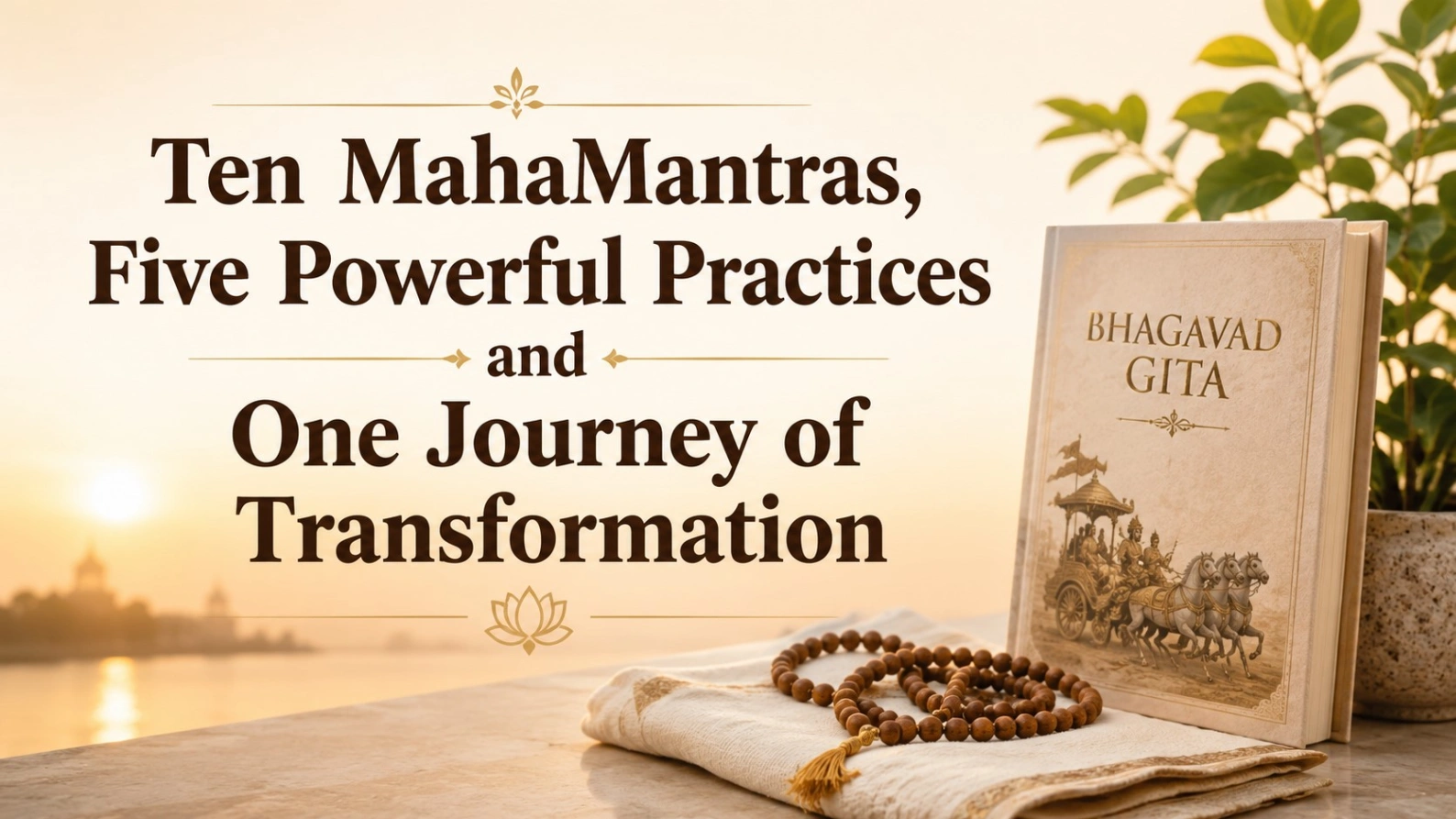
Every human being wants peace, happiness and a sense of direction. Yet, despite achieving external success, many people continue to experience restlessness, fear, confusion and dissatisfaction. The answer may not always lie in acquiring more. Sometimes, it lies in understanding life differently.
The powerful MahaMantras inspired by the timeless wisdom of the Bhagavad Gita offer a practical way to transform how we think, act and respond to life. These are not merely words to repeat during prayer. They are life-changing principles that can guide us through relationships, responsibilities, ambitions, failures and emotional struggles.
When these MahaMantras are supported by five powerful spiritual practices, they become part of our daily lives. Gradually, they take us from unconscious reactions to conscious living, from mental disturbance to inner peace and from confusion to self-realization.
This is the journey of transformation: ten MahaMantras, five practices and one sincere commitment to living with awareness.
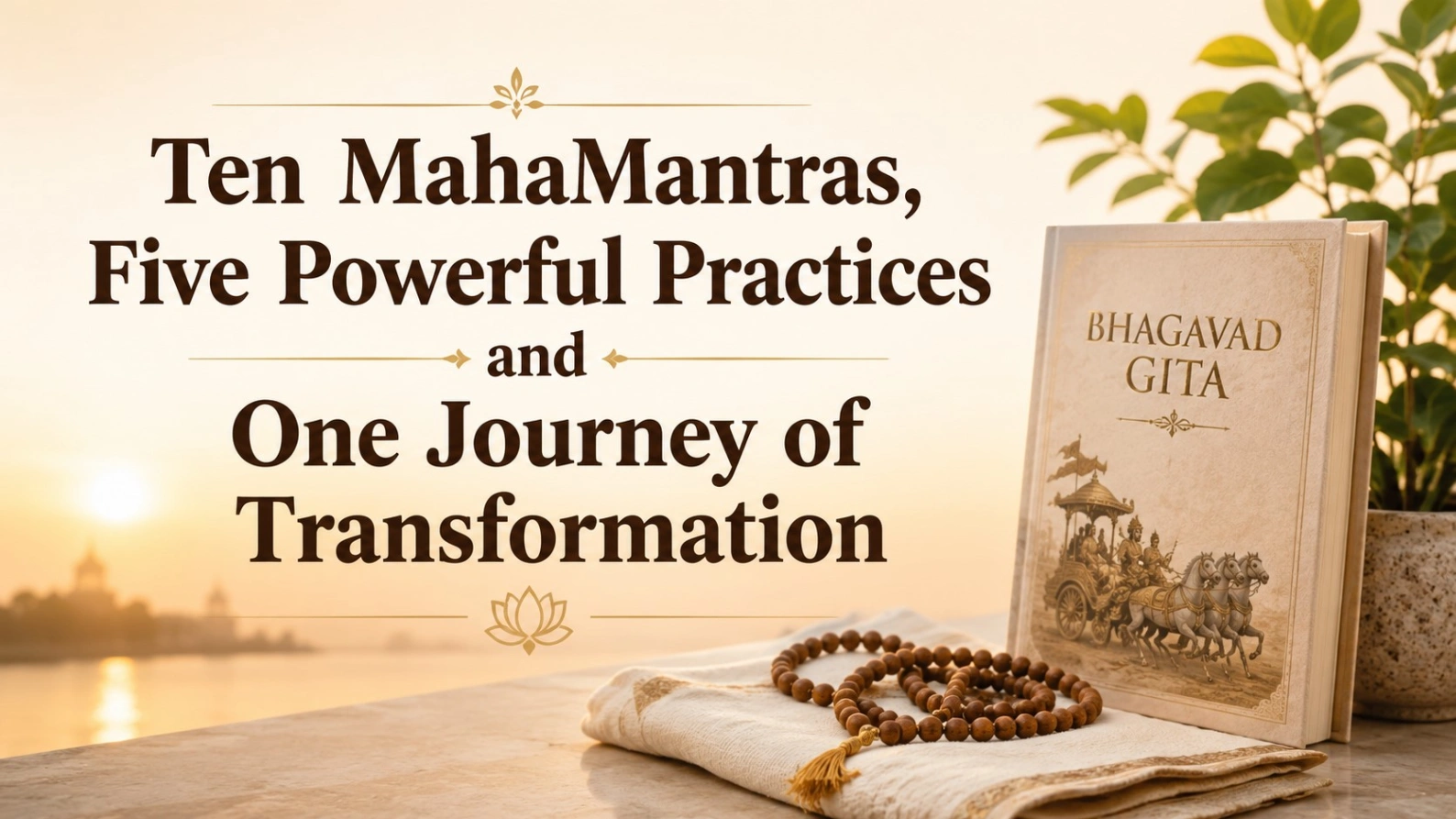
Why MahaMantras Are More Than Sacred Words
A mantra is traditionally understood as a sacred sound, phrase or teaching that protects and guides the mind. Mantra meditation and mantra chanting have been practised for centuries as methods of developing concentration, positive thinking and spiritual awareness.
However, a MahaMantra can also be understood as a great principle for living. It reminds us of a truth that the mind often forgets during difficult situations.
For example, we may know intellectually that everything changes, yet we still resist change. We may understand that effort is in our hands, yet we remain anxious about results. We may believe in forgiveness, yet continue carrying resentment.
Life-changing mantras help bridge the distance between what we know and how we actually live. They bring Bhagavad Gita teachings out of books and into our everyday choices.
The real power of a MahaMantra appears when it is remembered at the right moment. A teaching recalled during anger can prevent harmful words. A mantra remembered during failure can restore courage. A principle practised during uncertainty can bring mental clarity.
Design Your Destiny
Your destiny is shaped not only by external circumstances but also by the consciousness with which you respond to them. Join the Design Your Destiny program to learn practical spiritual principles, meditation techniques and powerful methods for overcoming limiting patterns.
Start Your Journey Today!The Bhagavad Gita as a Guide for Daily Life
The Bhagavad Gita is not limited to religious study. It is a profound conversation about human confusion, duty, fear, discipline, self-knowledge and spiritual growth.
Arjuna’s struggle represents the inner conflict experienced by almost every person. We frequently know what must be done, but emotions, attachments and fear make action difficult. Lord Krishna’s teachings help Arjuna develop clarity without asking him to escape his responsibilities.
This makes the Bhagavad Gita for daily life deeply relevant. Its wisdom can guide students, professionals, parents, entrepreneurs, spiritual seekers and anyone trying to live more consciously.
The Bhagavad Gita life lessons remind us to act sincerely, release unhealthy attachment to outcomes and discover the stable awareness beyond the changing mind. This ancient wisdom for modern life does not reject ambition or success. Instead, it teaches us how to pursue our goals without losing our peace.
Ten Powerful MahaMantras for Transformation
1. Accept What Is, Then Act Consciously
Acceptance does not mean becoming passive or tolerating injustice. It means seeing the present situation clearly before deciding what to do.
When we constantly argue with reality, we waste energy in frustration. Acceptance allows us to stop saying, “This should not have happened,” and begin asking, “What is the wisest action available now?”
This MahaMantra encourages emotional maturity. It replaces helplessness with conscious action and supports inner transformation.
2. Focus on Action, Not Anxiety About Results
One of the most well-known Bhagavad Gita teachings is to perform the right action without becoming mentally dependent on its result.
Attachment to outcomes creates fear before action, stress during action and disappointment after action. When our attention returns to effort, preparation and intention, we become more effective.
This does not mean that results are unimportant. It means that we should not sacrifice our mental peace to something that is not completely under our control.
3. Change Your Thoughts, Change Your Experience
The mind influences how we interpret every situation. Two people can face a similar challenge and experience it very differently because of their thoughts.
Mantras for positive thinking do not ask us to deny problems. They help us stop adding unnecessary negativity to them.
By observing limiting beliefs and replacing them with clarity, patience and constructive thinking, we gradually reshape our inner world. Positive thinking becomes powerful when it is supported by awareness and responsible action.

4. You Are the Witness, Not Every Thought
Thoughts constantly appear and disappear. Some are useful, while others are based on fear, comparison, memory or imagination.
Mindfulness and self-awareness help us observe thoughts without immediately believing them. When we become the witness, we create a space between thought and reaction.
This space is the beginning of freedom. We recognise that a negative thought is not necessarily the truth, an emotion is not a permanent identity and a difficult moment is not the whole story of our life.
5. Let Go of What You Cannot Control
The desire to control people, situations and future outcomes creates mental exhaustion. We may plan carefully, but life will always contain uncertainty.
Letting go is not weakness. It is the wisdom to distinguish between responsibility and unnecessary control.
This MahaMantra helps us act fully while releasing the burden of trying to manage everything. It is among the most powerful mantras for inner peace because it restores trust in life.
6. Difficulties Can Become Spiritual Teachers
Challenges often reveal qualities that comfort cannot develop. Patience, courage, discipline and compassion become stronger when they are tested.
A difficult experience does not automatically produce spiritual growth. Transformation occurs when we meet that experience consciously.
Instead of asking only, “Why is this happening to me?” we can also ask, “What is this situation teaching me?” This shift turns pain into wisdom and struggle into personal transformation.

7. Gratitude Changes the Energy of Life
The mind naturally notices what is missing. Gratitude trains it to recognise what is already present.
Daily mantras centred on gratitude can improve our relationship with ordinary life. A meal, supportive person, opportunity, lesson or peaceful moment becomes meaningful when it is consciously appreciated.
Gratitude does not deny sadness or difficulty. It prevents difficulty from hiding every blessing.
8. Discipline Creates Inner Freedom
Many people associate freedom with doing whatever they feel like doing. Yet uncontrolled habits often create dependence, distraction and regret.
Spiritual discipline helps us choose what supports our well-being. Regular meditation, mindful speech, healthy routines and self-reflection gradually strengthen the mind.
Discipline is therefore not punishment. It is the structure that allows spiritual growth and personal development to continue even when motivation is low.
9. See the Same Consciousness in Everyone
The Bhagavad Gita wisdom encourages us to look beyond external differences and recognise the deeper spiritual essence within all beings.
This understanding develops humility and compassion. It becomes harder to insult, manipulate or unnecessarily harm another person when we recognise the same consciousness within them.
Such awareness can improve relationships and reduce ego-driven conflict. It reminds us that spirituality must be expressed through behaviour, not merely discussed through words.
10. Your Life Can Become a Spiritual Practice
Spirituality is not separate from ordinary responsibilities. Work, family, relationships, challenges and decisions can all become part of the spiritual journey.
When an action is performed with awareness, sincerity and the right intention, it becomes meaningful. Cooking can become service. Listening can become compassion. Working can become discipline. Silence can become meditation.
This MahaMantra unites spiritual wisdom with practical life. It helps us understand that transformation does not require escaping the world. It requires changing the consciousness with which we participate in it.
Five Powerful Spiritual Practices for Daily Life
Understanding the MahaMantras is only the beginning. Their wisdom becomes transformative through consistent practice.
1. Daily Mantra Meditation
Choose one MahaMantra that feels relevant to your present situation. Sit quietly, breathe naturally and repeat it with attention.
Do not chant mechanically. Reflect on its meaning and notice how it applies to your life.
Even ten minutes of mantra meditation can help settle mental activity and bring the chosen teaching into deeper awareness. Morning mantras can also set a conscious direction for the entire day.
2. Mindful Observation
Spend a few minutes observing your thoughts, emotions and physical sensations without judgment.
This practice helps you recognise habitual reactions. You may notice how quickly the mind compares, complains, worries or seeks approval.
Observation itself creates transformation because what is seen clearly becomes easier to change. Mindfulness gradually strengthens emotional balance and self-awareness.

3. Self-Reflection and Journaling
At the end of the day, ask yourself a few simple questions:
What disturbed my peace today? How did I respond? Which MahaMantra could have guided me? What did I learn?
Writing honestly helps convert daily experiences into spiritual lessons. It also reveals repeating patterns that may otherwise remain unnoticed.
4. Selfless Action
Perform at least one action each day without expecting recognition or reward. Help someone, share knowledge, offer encouragement or complete a responsibility with sincerity.
Selfless action weakens ego and strengthens compassion. It also makes karma yoga a practical part of daily living.
The action does not need to be dramatic. Its value lies in the intention behind it.
5. Silence and Conscious Pausing
Create small periods of silence during the day. Put away distractions, stop speaking and simply remain present.
Also practise pausing before responding when emotions are intense. A conscious pause can prevent impulsive reactions and help you choose words wisely.
Silence allows inner wisdom to become audible. It is often within these quiet moments that clarity, acceptance and peace arise.
How MahaMantras Can Transform Your Life
Transformation rarely happens through one extraordinary moment. It develops through repeated, conscious choices.
When powerful mantras are practised regularly, they begin to influence how we respond to stress, failure, criticism and uncertainty. We become less controlled by immediate reactions and more capable of choosing our response.
Over time, mantra meditation may support mental clarity, spiritual awareness and emotional steadiness. Spiritual practices for personal growth can also help us understand the difference between temporary pleasure and lasting fulfilment.
The purpose is not to become emotionally numb or perfectly calm at all times. The purpose is to return to awareness more quickly whenever we lose balance.
A transformed person may still experience sadness, anger or fear. The difference is that these emotions no longer completely control their identity and decisions.
The One Journey of Spiritual Transformation
The ten MahaMantras and five powerful practices ultimately lead toward one journey: the journey from unconscious living to conscious awareness.
In the beginning, we may seek mantras for success, happiness or positive energy. These are natural desires. But as the spiritual journey deepens, the definition of success begins to change.
Success is no longer limited to achievement. It includes peace of mind, integrity, self-knowledge and the ability to remain centred during changing circumstances.
Spiritual awakening does not necessarily mean experiencing something mysterious. It can begin with a simple realisation: “I do not have to remain trapped in my old patterns.”
Every conscious thought, compassionate action and moment of self-observation takes us closer to inner freedom.

Bringing Ancient Wisdom into Modern Life
Modern life is filled with speed, information and constant stimulation. We may be connected digitally while feeling disconnected internally.
This is why Bhagavad Gita teachings and powerful MahaMantras remain meaningful. They bring attention back to the essential questions: Who am I beyond my roles? What is the purpose of life? How can I act without losing myself in the outcome? What creates genuine inner peace?
Ancient wisdom for modern life does not require rejecting technology, career or ambition. It encourages balance. We can participate fully in the world while remaining connected to our inner centre.
When spiritual wisdom becomes practical, ordinary life itself turns into a path of awakening.
Ten MahaMantras, five powerful practices and one journey of transformation offer a complete framework for conscious living.
The MahaMantras provide direction. The practices turn understanding into experience. The journey gradually leads from fear to trust, attachment to freedom, reaction to awareness and mental restlessness to inner peace.
You do not need to practise everything perfectly from the first day. Begin with one mantra, one conscious pause or a few minutes of meditation. Small practices performed consistently can create meaningful inner transformation.
The Bhagavad Gita reminds us that wisdom becomes valuable when it is lived. Allow these life-changing mantras to guide your thoughts, actions and choices. With patience and sincere practice, your everyday life can become a journey of spiritual growth, self-realization and lasting transformation.
Personal Session
Every person’s challenges, emotional patterns and spiritual journey are different. A personal session can help you understand what is holding you back and identify the practices most relevant to your present situation.
Book Now