

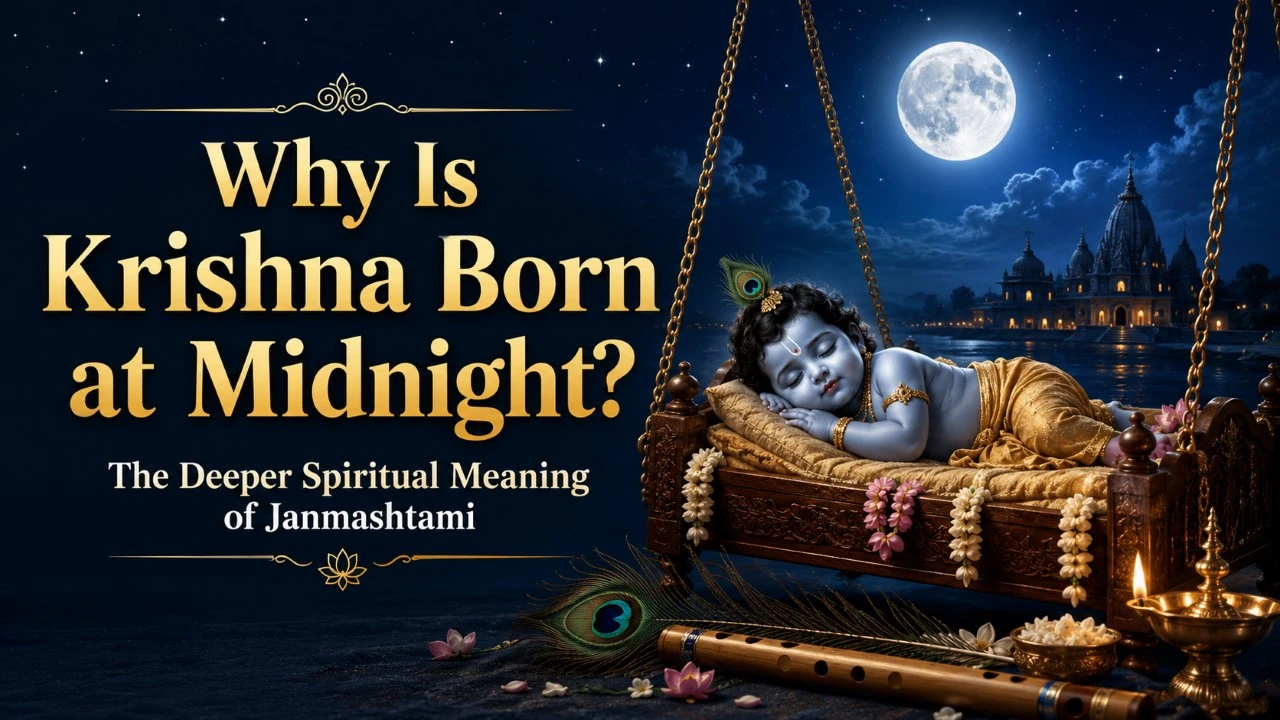
Every year on Krishna Janmashtami, devotees wait eagerly for midnight. Temples remain illuminated, bhajans fill the air, devotees fast throughout the day, and as the clock approaches twelve, the atmosphere changes. At midnight, the birth of Lord Krishna is celebrated with prayers, bells, conch shells, devotional songs and the ceremonial appearance of Bal Krishna.
But have you ever wondered: Why is Krishna born at midnight?
Why did the divine birth of Krishna take place during the darkest hours of the night rather than at sunrise or during the day?
According to the traditional account in the Srimad Bhagavatam, Krishna appeared to Devaki and Vasudeva while they were imprisoned by King Kamsa. The scripture describes His appearance during the dense darkness of night, comparing it to the full moon rising and illuminating the darkness.
For devotees and spiritual seekers, Krishna's midnight birth is therefore more than a historical or religious event. It carries a profound spiritual message: when darkness appears deepest, divine consciousness can awaken within us.
Let us understand the deeper meaning behind Krishna's birth at midnight and what Janmashtami can teach us about our own spiritual journey.
Why Was Lord Krishna Born at Midnight?
The traditional story of Krishna's birth begins in Mathura.
King Kamsa had imprisoned his sister Devaki and her husband Vasudeva after learning of a prophecy that Devaki's eighth child would bring about his downfall.
Kamsa lived in fear of that prophecy. Devaki and Vasudeva remained imprisoned, and their children faced Kamsa's cruelty.
Then came the birth of their eighth child, Krishna.
The Srimad Bhagavatam describes Krishna's divine appearance in the darkness of night. After His appearance, Vasudeva was able to leave the prison carrying the newborn Krishna and take Him across to Gokul, where He was placed beside Yashoda.
This is why the traditional celebration of Krishna Janmashtami reaches its spiritual climax around midnight.
Yet the symbolism behind the story is even more powerful.
Design Your Destiny
Krishna's birth reminds us that transformation begins when the light of awareness enters our inner world. Design Your Destiny is an opportunity to understand yourself more deeply, break limiting patterns and learn how spiritual wisdom can be applied to everyday life. Begin your journey from unconscious living to conscious transformation with Design Your Destiny.
Start Your Journey Today!1. Midnight Represents the Darkness of Ignorance
One of the most beautiful spiritual interpretations of Krishna's midnight birth is that darkness represents ignorance.
In spiritual philosophy, darkness often symbolizes:
Lack of self-awareness
Ego
Fear
Attachment
Confusion
Unconscious living
Forgetfulness of our deeper nature
Krishna appears in the middle of darkness because divine wisdom is needed precisely when consciousness has become clouded.
Think about your own life.
We often remember spirituality when everything appears uncertain—when relationships become difficult, ambitions fail, anxiety increases or we no longer know which direction to take.
These become our personal "midnights."
Krishna's birth reminds us that darkness does not mean that light has disappeared forever. It can become the very moment in which light is born.
2. Krishna's Birth Symbolizes the Awakening of Inner Light
When people ask, “Why Krishna was born at midnight?”, the simplest spiritual answer may be:
Krishna represents the awakening of divine light in the darkness of human consciousness.
The Srimad Bhagavatam beautifully describes the Lord appearing in the darkness like the full moon rising on the horizon.
This symbolism is deeply relevant even today.
You may be surrounded by uncertainty, but clarity can still arise.
You may experience fear, but courage can still awaken.
You may be struggling internally, but awareness can still emerge.
Janmashtami therefore becomes more than the celebration of Krishna's birth thousands of years ago.
It becomes an invitation to ask:
“Has Krishna—the light of awareness—been born within me?”
3. The Prison Represents Our Inner Bondage
Krishna was born while Devaki and Vasudeva were confined in Kamsa's prison.
Spiritually, the prison can be understood as a symbol of everything that binds human consciousness.
Our prisons may not have physical walls.
They can be:
Attachment to approval
Fear of failure
Anger toward another person
Constant comparison
Desire for control
Identification with status and possessions
Repetitive negative thinking
Ego-driven expectations
A person may appear completely free externally while remaining imprisoned internally.
Krishna's birth inside a prison offers a powerful message:
You do not have to wait until every external problem disappears before beginning your spiritual awakening.
Freedom can begin inside you even while circumstances remain difficult.
Janmashtami 2026 Date and Time: Puja Muhurat and Tithi
4. Kamsa Symbolizes Fear and the Ego
Kamsa spends much of Krishna's birth story driven by fear.
He wants control because he is terrified of losing control.
This makes him a powerful symbol of the egoic mind.
The ego continually asks:
“What will happen to me?”
“What if I lose?”
“What if someone becomes greater than me?”
“How can I control the future?”
Kamsa's actions demonstrate what happens when fear becomes the ruler of consciousness.
Krishna represents the opposite.
Krishna represents wisdom, consciousness, love and freedom.
Therefore, the story can also be understood as an inner struggle between fear-based consciousness and awakened consciousness.
Janmashtami invites us to observe which one is governing our own lives.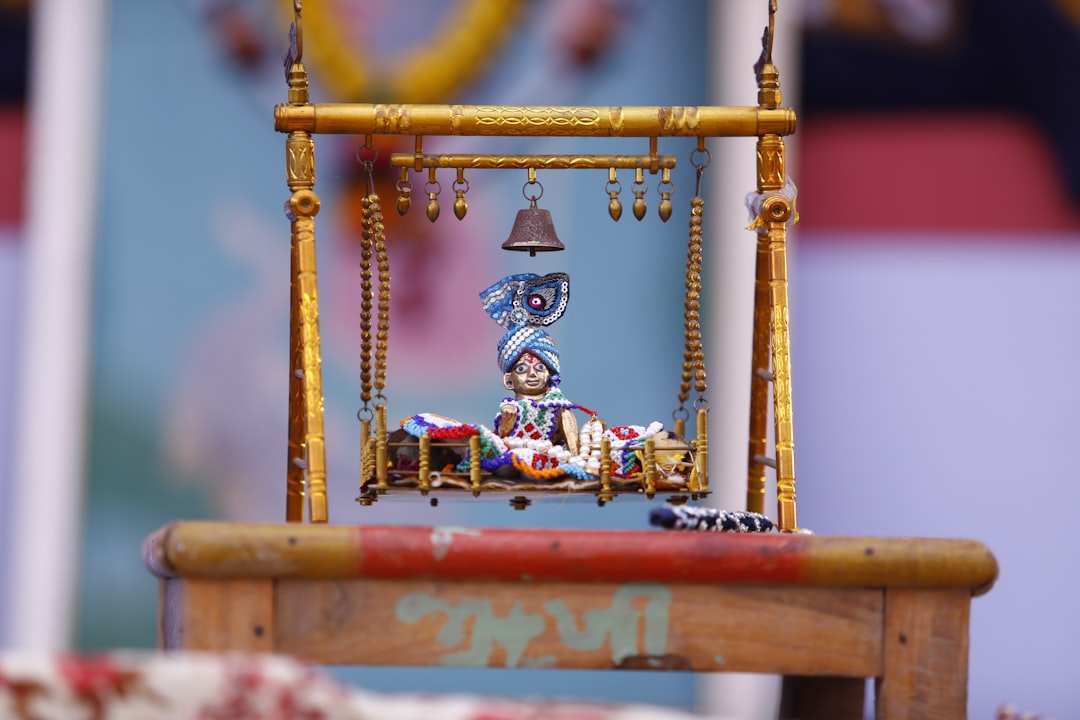
5. Midnight Is the Meeting Point Between Two Days
Midnight is neither fully yesterday nor fully tomorrow.
It is a point of transition.
Symbolically, this makes Krishna's midnight appearance especially meaningful.
Spiritual transformation also requires a transition:
From unconsciousness to awareness.
From attachment to inner freedom.
From fear to trust.
From ego to surrender.
From identification with the mind to knowledge of one's deeper Self.
Whenever the old way of living begins to dissolve and a new consciousness begins to emerge, we experience an inner midnight.
Krishna's birth therefore represents transformation at the threshold between darkness and awakening.
6. Why Is Silence Important in Krishna's Midnight Birth?
Midnight naturally carries an atmosphere of stillness.
During the day, attention constantly moves outward.
There are conversations, responsibilities, notifications, ambitions, decisions and distractions.
At night, much of that external noise disappears.
This gives midnight another beautiful symbolic meaning: truth becomes visible when the inner noise becomes silent.
Krishna-consciousness cannot be understood only through intellectual analysis.
There must also be inner stillness.
When thoughts slow down and the constant demand to become, achieve or prove something temporarily disappears, we become more capable of observing consciousness itself.
Janmashtami can therefore become an opportunity not merely to stay awake until midnight, but to become inwardly awake.
7. Krishna Is Born When Hope Seems Impossible
Consider the circumstances surrounding the Krishna birth at midnight.
His parents were prisoners.
Kamsa was powerful.
The future looked uncertain.
Externally, the circumstances were anything but ideal.
And yet the divine appeared.
This teaches one of Janmashtami's most comforting spiritual lessons:
Never assume that difficult circumstances mean transformation is impossible.
Sometimes the deepest wisdom develops during our greatest challenges.
Sometimes loss creates detachment.
Sometimes uncertainty creates surrender.
Sometimes failure destroys an identity we had outgrown.
Sometimes darkness makes us search seriously for light.
Krishna's midnight birth therefore becomes a symbol of hope, not superficial optimism, but the deeper understanding that consciousness can awaken even in circumstances we did not choose.
8. Why Do Devotees Celebrate Janmashtami at Midnight?
Devotees traditionally observe Janmashtami through fasting, prayer, bhajans, scripture reading and worship of Bal Krishna.
The central celebration occurs during Nishita, the traditional midnight period associated with Krishna's appearance.
In 2026, Krishna Janmashtami falls on Friday, September 4, 2026. In New Delhi, the Nishita Puja period is approximately 11:57 PM on September 4 to 12:43 AM on September 5, although exact local timings differ by city.
At midnight, temples commonly celebrate Krishna's appearance with:
Abhishek of Bal Gopal
Aarti
Bhajans and kirtan
Offering of sweets and fruits
Jhula or cradle ceremonies
Chanting Krishna's names
Distribution of prasad
But alongside these rituals, Janmashtami provides an opportunity for inner reflection.
Varalakshmi Puja at Home: Step-by-Step Puja Vidhi and Rules
9. What Does Krishna Janmashtami Teach Us Today?
The spiritual meaning of Krishna Janmashtami remains deeply relevant to modern life.
Many people today experience an entirely different kind of darkness stress, constant comparison, loneliness, information overload, dissatisfaction and overthinking.
We may have more convenience than previous generations, yet still struggle to find inner peace.
Krishna's midnight birth teaches us to search for light within consciousness rather than only through external circumstances.
Instead of asking only:
“How can I change everything around me?”
Spirituality asks:
“How can I change the consciousness through which I experience everything?”
That transformation changes the way we live.
10. Let Krishna Be Born Within You
The deepest celebration of Janmashtami may not be external.
The real celebration begins when Krishna's teachings become alive inside us.
Krishna is born within us when:
Awareness replaces unconscious reaction.
You notice anger before becoming anger.
Wisdom replaces confusion.
You choose what is right instead of what is merely comfortable.
Detachment replaces compulsive attachment.
You perform your actions sincerely without allowing outcomes to control your inner state.
Love replaces ego.
Relationships become opportunities to give rather than possess.
Surrender replaces excessive control.
You learn to act wholeheartedly while accepting what cannot be controlled.
This is how Janmashtami becomes a living spiritual experience rather than merely an annual festival.
Krishna Janmashtami 2026: Date and Midnight Puja
For devotees searching for Krishna Janmashtami 2026, the festival falls on:
Date: Friday, September 4, 2026
Ashtami Tithi begins: September 4, 2026
Midnight/Nishita worship: Late night of September 4 into September 5, depending on location.
For example, the traditional Nishita Puja period calculated for New Delhi is 11:57 PM to 12:43 AM. Puja timings vary by location, so devotees should check the Panchang for their own city.
The Deeper Meaning of Janmashtami
So, why was Lord Krishna born at midnight?
At the narrative level, Hindu tradition commemorates Krishna's appearance during the darkness of night.
At the spiritual level, midnight offers an extraordinary metaphor.
The darkness is ignorance.
The prison is bondage.
Kamsa is fear and ego.
The chains are attachments.
And Krishna is awakened consciousness.
The message is timeless:
No darkness is so complete that awareness cannot arise within it.
Perhaps this is why millions of people remain awake on Janmashtami night.
The invitation is not merely to keep the eyes open.
It is to awaken consciousness.
This Janmashtami, as you celebrate the birth of Krishna, ask yourself:
What darkness within me needs the light of awareness?
Which inner chains am I ready to release?
Can Krishna's wisdom become something I live rather than something I only worship?
When wisdom enters daily life, Janmashtami becomes more than the celebration of Krishna's birth.
It becomes the beginning of our own inner transformation.
Personal Session
Sometimes we understand spiritual teachings intellectually but struggle to apply them to relationships, emotions, decisions and recurring life patterns. A Personal Session can help you explore your challenges with greater clarity and discover a more conscious way forward. Book your Personal Session and take the next step toward clarity, awareness and inner transformation.
Book Now