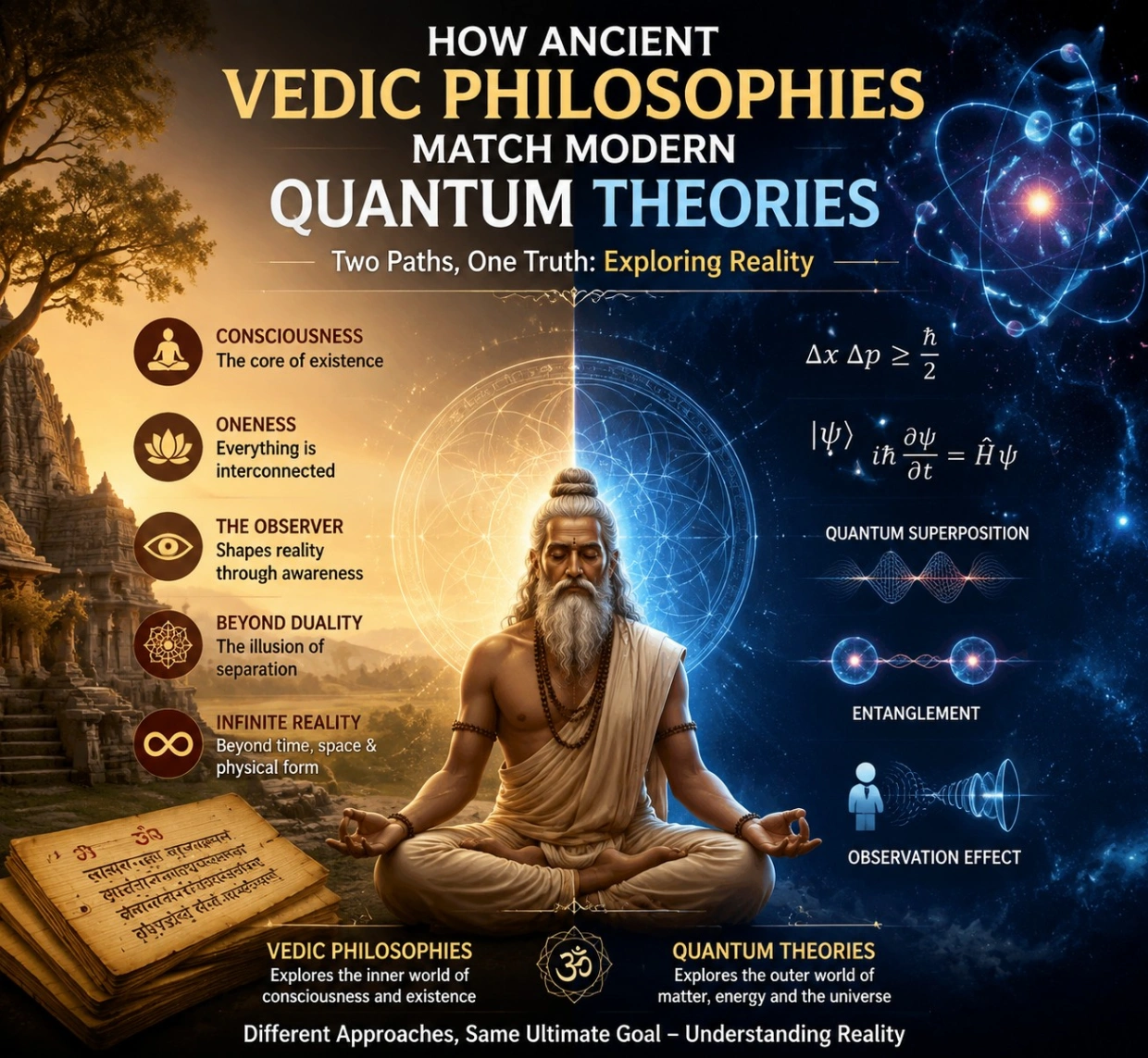
For thousands of years, humans have searched for answers to some of the deepest questions of existence: What is the nature of reality? What is consciousness? How is everything in the universe connected? Ancient Indian thinkers explored these questions through Vedic philosophy and quantum physics approaches, although they emerged from completely different worlds.
Vedic philosophy comes from ancient spiritual and philosophical traditions that explore consciousness, the self, and the relationship between humans and the universe. Quantum physics, on the other hand, is a modern scientific field that studies the behavior of matter and energy at the smallest possible scales. While one is based on spiritual inquiry and the other on scientific experiments, both explore mysteries that continue to challenge human understanding.
The connection between ancient Vedic wisdom and modern quantum theories has gained attention because both discuss ideas related to interconnectedness, the nature of reality, and the role of observation. However, it is important to understand that similarities between these fields are philosophical interpretations rather than proof that ancient texts contained modern scientific theories.
Let us explore how ancient Vedic philosophies and modern quantum physics approach some of the biggest mysteries of existence.
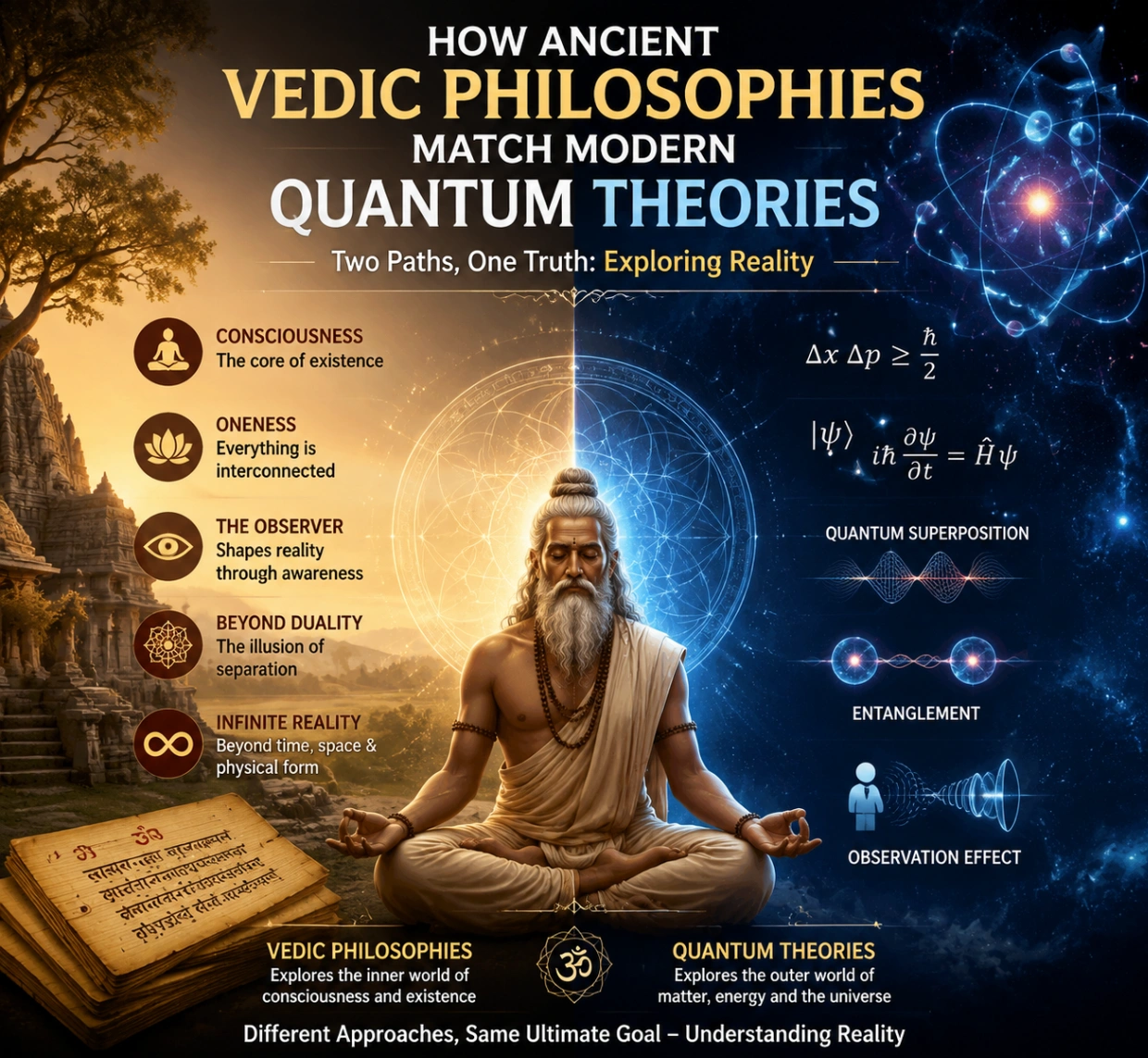
Understanding Ancient Vedic Philosophy
The word “Veda” means knowledge. The Vedic tradition represents one of the oldest systems of philosophical thought, focusing on understanding life, consciousness, the universe, and the connection between the individual and the greater existence.
Unlike modern science, which primarily studies the external world through observation and measurement, Vedic philosophy also explores the inner world through meditation, self-reflection, and spiritual practices.
One of the central ideas in Vedic philosophy is that there is a deeper reality beyond everyday perception. Ancient thinkers questioned whether the physical world we experience represents the complete truth or only a limited view of a much larger reality.
Concepts such as Brahman, the universal reality, and Atman, the individual self, explore the relationship between individual consciousness and the universe. These ideas have inspired generations of philosophers and spiritual seekers to explore the connection between human awareness and cosmic existence.
The Vedic approach encourages individuals to look beyond external experiences and understand the deeper nature of consciousness.
Design Your Destiny
Your thoughts, awareness, and choices influence the way you experience life. Ancient wisdom and modern understanding both remind us that true transformation begins from within. Through Design Your Destiny, discover powerful tools for self-awareness, personal growth, and creating a more meaningful life.
Start Your JourneyWhat Is Quantum Physics and Why Is It Fascinating?
Quantum physics is one of the most revolutionary discoveries in modern science. It studies particles at extremely small scales, such as atoms and subatomic particles.
Unlike classical physics, where objects behave in predictable ways, quantum physics reveals a world where uncertainty, probability, and unusual interactions exist.
Some important concepts in quantum theory include:
Quantum uncertainty: The idea that certain properties of particles cannot be predicted with complete certainty before measurement.
Wave-particle duality: The discovery that tiny particles can behave both like waves and particles.
Quantum entanglement: A phenomenon where particles can remain connected in ways that challenge traditional understanding of distance and interaction.
Observer effect: The idea that the process of measurement influences what is observed in quantum experiments.
These discoveries changed the way scientists understand reality and opened new discussions about the relationship between observation, consciousness, and the universe.
The Connection Between Vedic Philosophy and Quantum Physics
The relationship between Vedic philosophy and quantum physics is often discussed because both explore questions that go beyond ordinary human experience.
However, the similarities are mainly philosophical rather than scientific.
Both traditions encourage us to question assumptions about reality.
In everyday life, we experience the world as separate objects: separate people, separate things, and separate events. But both Vedic teachings and quantum discussions often highlight the idea that everything may be more interconnected than it appears.
Vedic philosophy describes the universe as a connected whole where everything arises from a deeper reality. Similarly, quantum physics reveals that at the fundamental level, particles and energy interact in complex and interconnected ways.
This does not mean that quantum physics proves Vedic philosophy or that ancient texts contained quantum equations. Instead, both offer different perspectives on exploring existence.
Science asks:
“How does the universe work?”
Vedic philosophy asks:
“What is the deeper meaning of existence?”
Together, they represent two different approaches to understanding reality.
The Mystery of Consciousness: Where Science Meets Spirituality
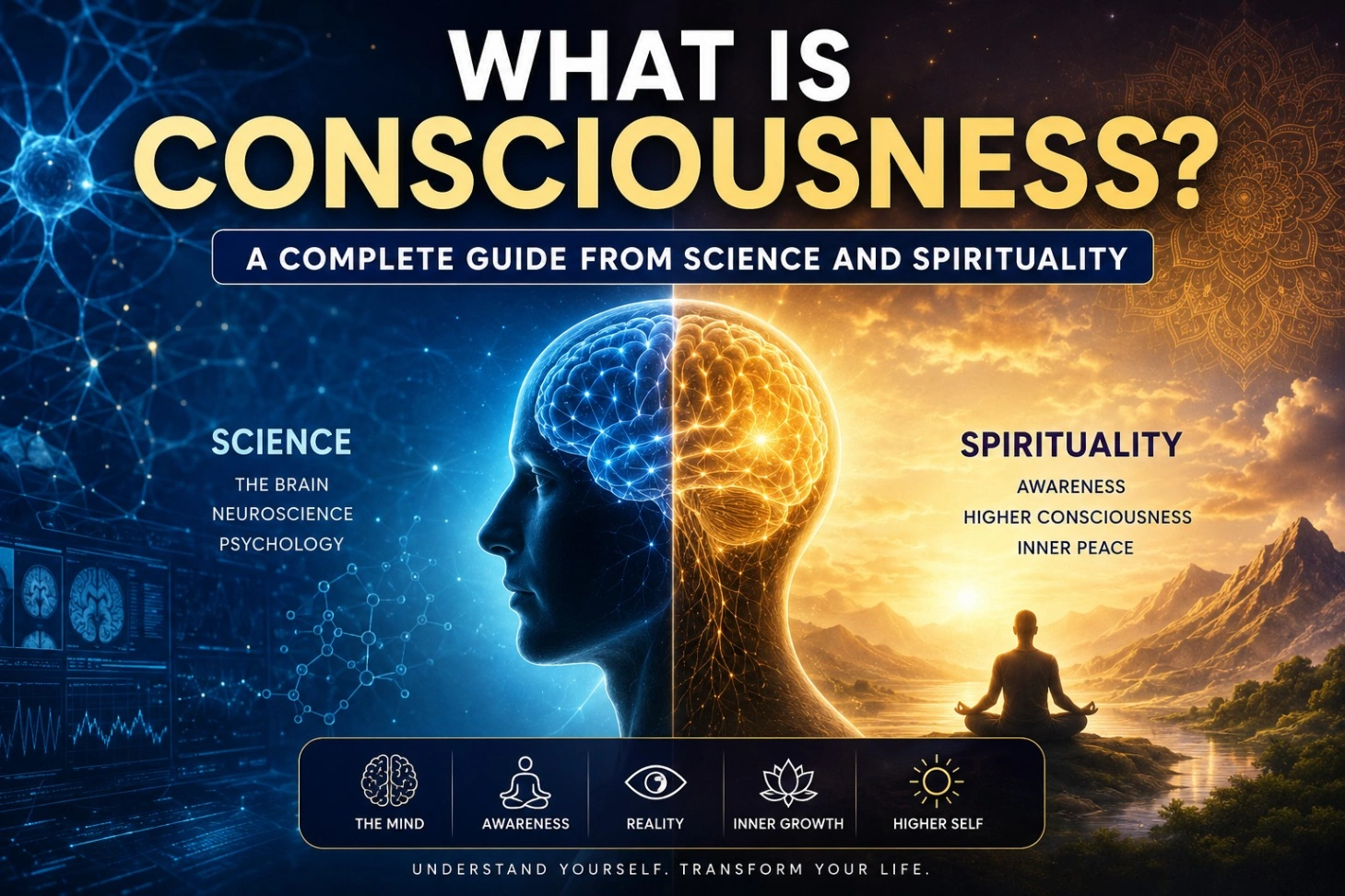
One of the biggest areas where quantum physics and spirituality discussions overlap is consciousness.
Consciousness remains one of the greatest mysteries in science. Scientists understand many functions of the brain, but the exact nature of subjective experience, awareness, and self-consciousness is still being explored.
Vedic philosophy places consciousness at the center of existence. Many Vedic teachings suggest that awareness is not simply a product of physical processes but a fundamental aspect of reality.
Modern science continues to investigate questions such as:
How does consciousness arise?
Is consciousness only a function of the brain?
How does awareness create our experience of reality?
Some researchers have explored whether quantum processes may play a role in consciousness, but there is currently no scientific consensus proving a quantum explanation for human awareness.
The fascination comes from the fact that both ancient wisdom and modern science recognize consciousness as one of the greatest mysteries of human existence.
Did Ancient Vedic Knowledge Understand the Universe?
Many people wonder whether ancient Vedic texts contained knowledge similar to modern scientific discoveries.
The Vedic tradition includes deep philosophical discussions about creation, existence, time, and consciousness. Ancient thinkers asked questions about the origin of the universe and the nature of reality thousands of years ago.
For example, Vedic literature contains reflections on:
The origin of existence
The relationship between humans and the cosmos
The nature of awareness
The connection between individual experience and universal reality
These ideas demonstrate the remarkable curiosity of ancient thinkers.
However, it is important to differentiate between philosophical exploration and scientific theories. Modern physics is built upon mathematical models, experiments, and technological observations, while Vedic philosophy approaches reality through contemplation and spiritual insight.
The value of ancient wisdom lies not necessarily in predicting modern science but in encouraging humanity to explore deeper questions.
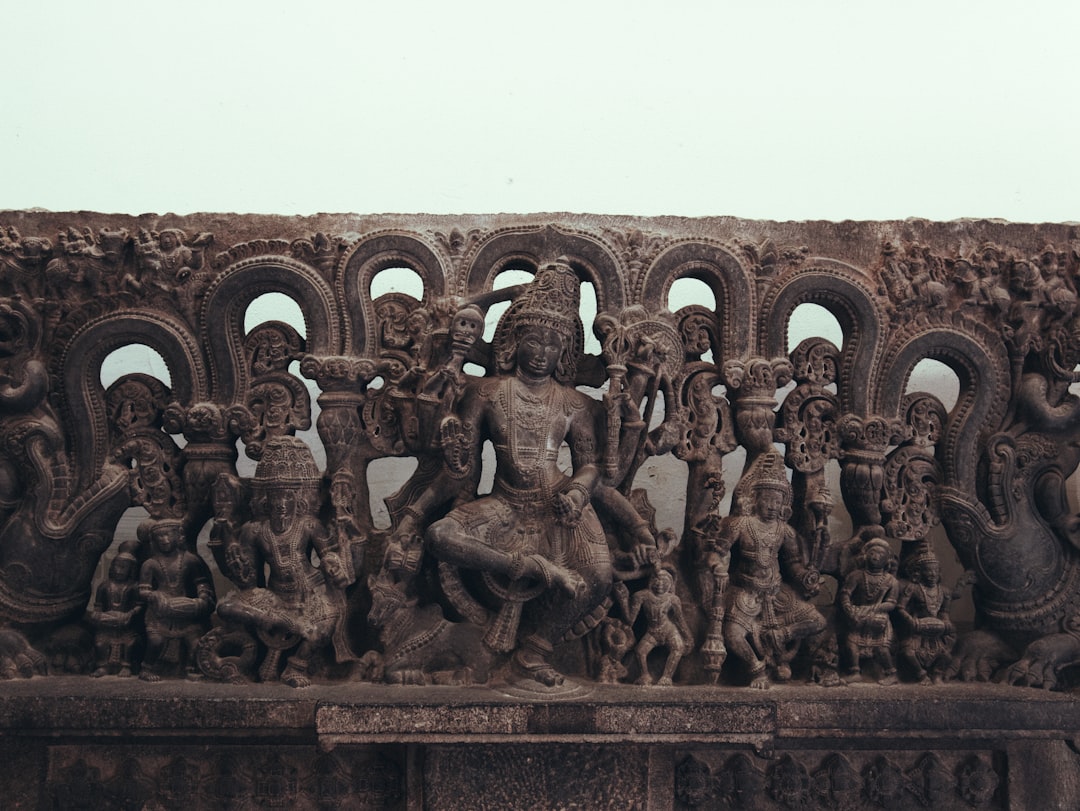
Observer Effect: A Bridge Between Two Worlds?
The observer effect in quantum physics is one of the concepts that often creates discussions between science and spirituality.
In quantum experiments, measurement affects the state of quantum systems. This has led some people to explore connections between observation and consciousness.
Vedic philosophy also places importance on awareness and perception. It teaches that our experience of reality is influenced by the state of our consciousness.
However, the scientific observer effect does not mean that human thoughts directly create physical reality. Quantum measurement involves specific physical interactions studied through experiments.
The similarity lies in the philosophical question:
How does our awareness influence our experience of the world?
This question continues to inspire both scientists and spiritual thinkers.
Ancient Wisdom and Modern Science: Two Ways of Exploring Reality
Science and spirituality are often presented as opposing ideas, but they can also be viewed as different methods of exploration.
Science investigates the external universe through observation, experimentation, and evidence.
Spiritual traditions investigate inner experience through meditation, awareness, and self-discovery.
Ancient Indian philosophy focused deeply on questions that modern science is still exploring:
What is consciousness?
Why does the universe exist?
What is the relationship between the observer and reality?
Are humans connected to a larger cosmic system?
Modern discoveries in physics have expanded our understanding of the universe, while ancient philosophies continue to provide insights into human experience.
Both encourage curiosity, humility, and the willingness to explore beyond ordinary perception.
The Future of Consciousness Studies
As science continues to advance, researchers are exploring new areas such as neuroscience, artificial intelligence, quantum theories, and consciousness studies.
The future may bring deeper understanding of how the brain creates awareness and how humans experience reality.
At the same time, ancient philosophies like Vedanta continue to influence discussions about mindfulness, meditation, self-awareness, and personal transformation.
The growing interest in quantum consciousness and ancient wisdom reflects humanity’s ongoing search for answers about existence.
Perhaps the most important lesson from both approaches is that reality may be far more complex than what we experience through our everyday senses.
Exploring the Infinite Mystery of Reality
The connection between Vedic philosophy and quantum physics represents a fascinating conversation between ancient wisdom and modern science.
While Vedic teachings and quantum theories come from different foundations, they both encourage humanity to explore deeper questions about consciousness, reality, and the universe.
Ancient sages searched for answers through inner exploration, while modern scientists investigate through experiments and mathematics. Both journeys reflect the same human desire: to understand our place in the vast universe.
The meeting point between science and spirituality is not about proving one through the other. Instead, it is about expanding our curiosity and recognizing that the mysteries of existence are still unfolding.
Personal Session
Every person carries unique experiences, patterns, and possibilities. A personalized session can help you gain clarity, understand yourself better, and create meaningful changes in your personal and spiritual journey. Take the first step toward greater awareness, balance, and growth.
Book Now